GPT-5.6 Sol and Terra vs. GPT-6 Astra: Which Model Is Most Efficient?
The same question produced nearly the same recommendation across three settings, but the research path and decision-making process differed.
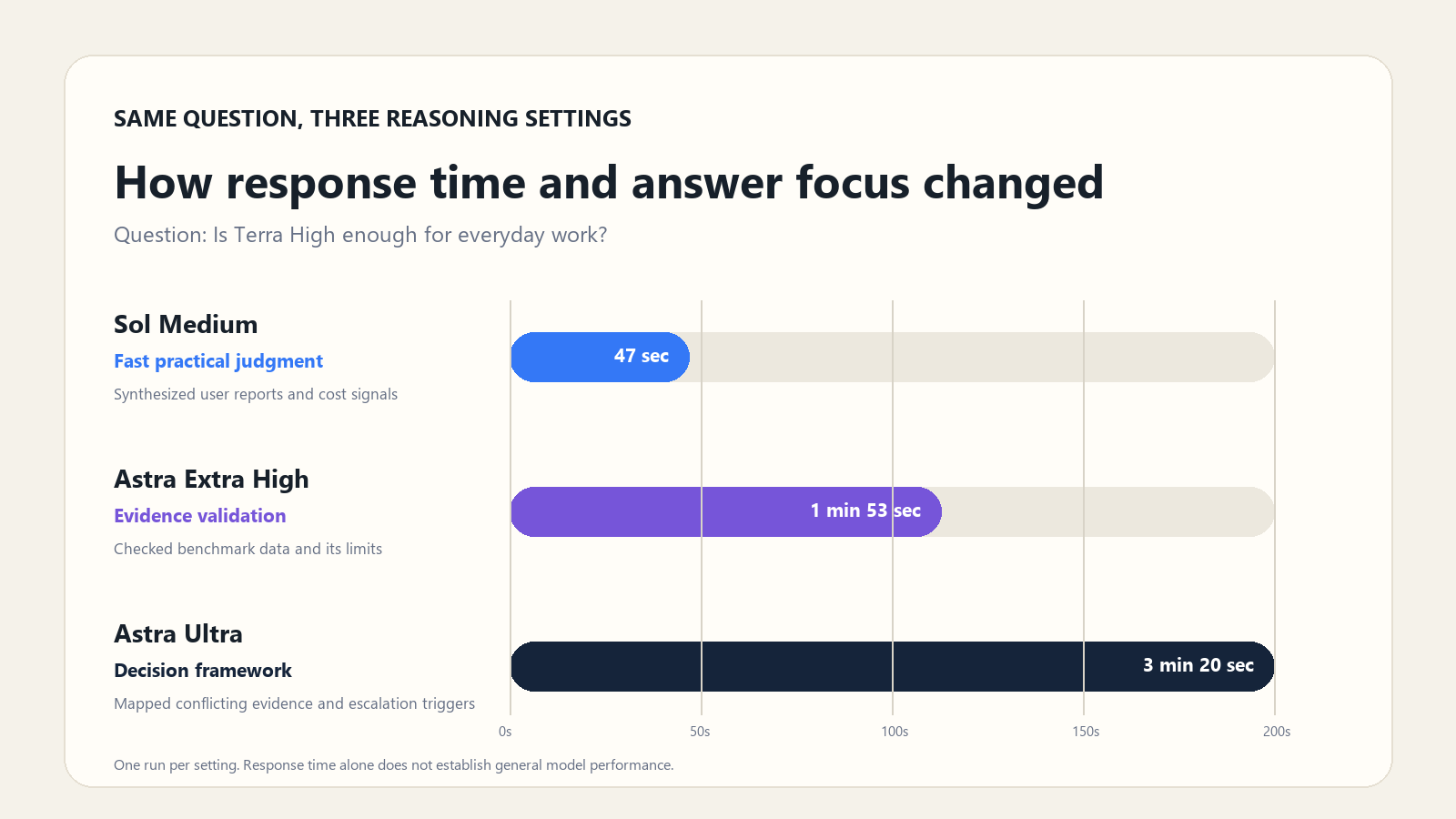
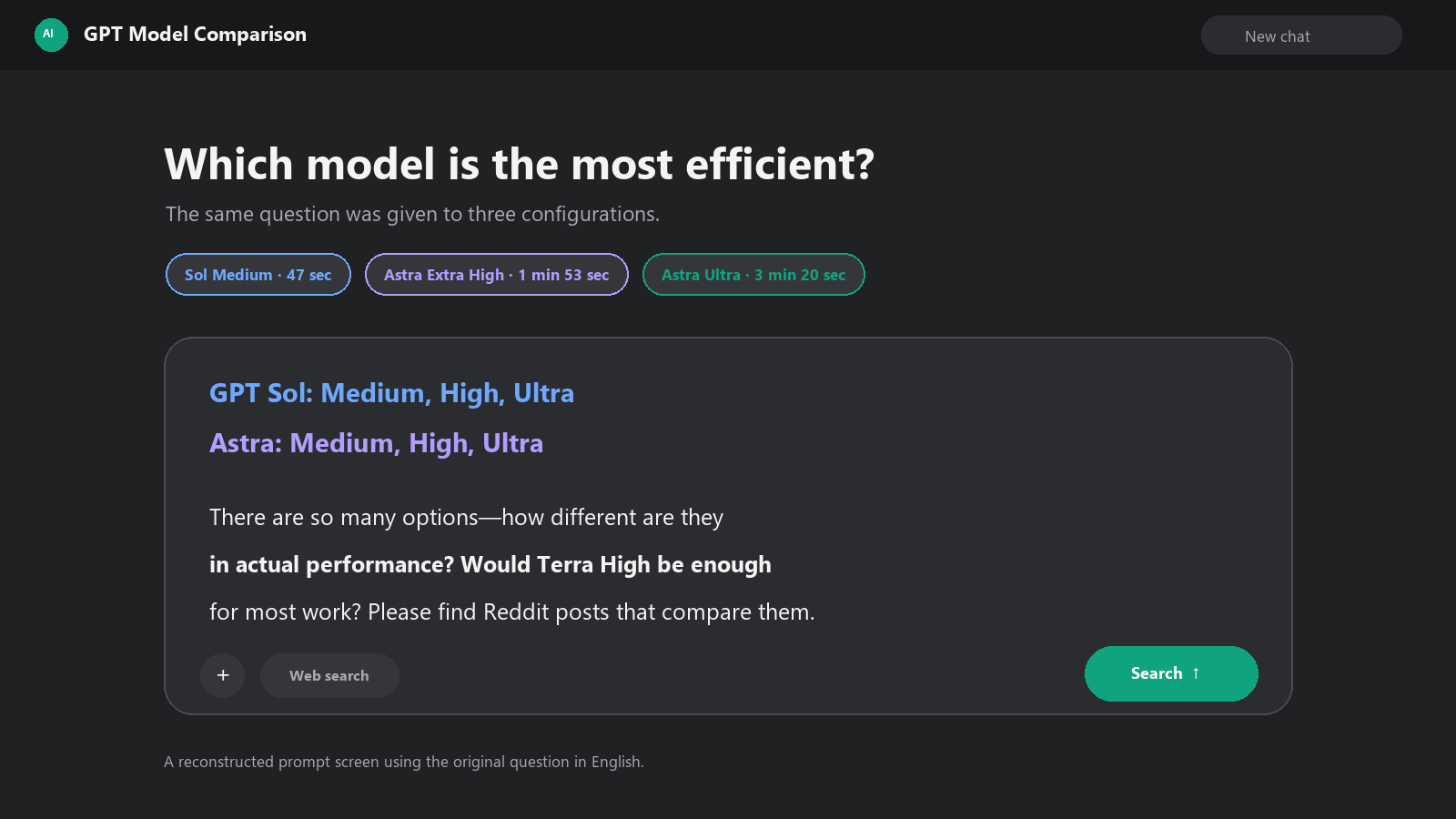
The question was straightforward: “Is Terra High enough for most everyday work?” Sol Medium responded in 47 seconds, Astra Extra High in 1 minute 53 seconds, and Astra Ultra in 3 minutes 20 seconds. Ultra took about 4.3 times as long as Sol Medium.
More time did not make every part of the answer better. Each setting added a different kind of value.
Sol Medium in 47 seconds: the fastest usable answer
Sol Medium synthesized Reddit experiences and cost signals into a practical recommendation: use Terra High for routine work, then move to Sol or Astra for complex architecture and debugging.
The answer was concise and easy to apply. Its main limitation was that it sometimes treated choices such as Terra High and Sol Medium as points on a single performance ladder, even though their strengths depend on the task.
Evidence: OpenAI model comparison · Sol Medium vs. High user discussion
Astra Extra High in 1 minute 53 seconds: stronger evidence checking
Astra Extra High looked more actively for quantitative evidence about whether higher reasoning effort improves results. In one independent test using the same 98 tasks, Medium solved 91, while High and Extra High each solved 95.
That result suggests a gain from Medium to High, with no additional score increase at Extra High in that test. It was a single run on a specific problem set, so it cannot establish general coding performance. It does show why more reasoning effort may have diminishing returns.
Evidence: 98-task Astra reasoning comparison · OpenAI model guide
Astra Ultra in 3 minutes 20 seconds: a framework for choosing
Astra Ultra searched more broadly and placed conflicting user reports side by side. It also separated model choice from reasoning effort: Terra, Sol, and Astra describe different model profiles, while Medium, High, and Ultra control how much reasoning and execution a task receives.
Its most useful contribution was an escalation rule. Instead of judging a setting by answer length or thinking time, track missed requirements and the amount of human rework. The broader search did not make every source stronger, however, because much of the evidence still came from individual user reports.
Evidence: OpenAI model selection guide · Sol Ultra user experience
Which setting was the most efficient?
In this comparison, each setting played a different role:
Sol Medium: rapid research, drafting, and routine decisions
Astra Extra High: checking important claims and quantitative comparisons
Astra Ultra: resolving conflicting evidence and defining escalation criteria
Sol Medium produced the answer, Astra Extra High tested the answer, and Astra Ultra built a rule for when to use it.
Sol Medium was the most efficient setting in this test. Astra Extra High justified its extra time when the output would support an important external claim or a decision with a high cost of failure. Ultra made the most sense when evidence conflicted and the work could benefit from broader, parallel analysis.
This was one observed run per setting. Response time varies with search conditions and conversation context, so these results should not be treated as a general benchmark of model speed or quality.
Evidence: OpenAI model comparison · 11 days of Codex usage data
Sources and further reading
OpenAI model comparison
OpenAI model guide
Astra reasoning-effort comparison
11 days of Codex usage data