What Can One Question Reveal in 12 Directions?
I started by looking up the Korean word for “question.” In Chinese characters, it is written 質問. The second character, 問, also appears in 問病, the word for visiting someone who is ill. That same character is used both when we ask about something we do not know and when we check on someone. What are we asking for when we ask a question?
Four Ways to Ask
Classical Chinese 問

In Book 3 of the Analects, Confucius enters the ancestral temple and asks about everything. When someone takes this as a sign that he does not know the rites, Confucius replies, “That is the rite.” I read this as a reminder that asking can be part of how we show respect. The same idea came to mind with 問病, where asking after someone is part of visiting them.
Sources The Analects, Book 3, §15 · National Institute of Korean Language, 질문 (question) · National Institute of Korean Language, 문병 (visiting the sick)
Latin quaerere

The English word question came through Anglo-French from Latin quaestio. Its earlier root, quaerere, means “to seek” or “to ask.” When we want to know something, we can ask a person or compare clues ourselves. The word made me think about how closely asking and investigating can go together.
Sources Lewis & Short, quaestio · Merriam-Webster, question
Old English āscian

English ask comes from Old English āscian. The Old English dictionary records both seeking information and asking for something. Today, you can ask about the delay or ask for help. What you ask for changes what you expect from the other person.
Sources Bosworth–Toller, ascian · Merriam-Webster, ask
Hebrew שָׁאַל

In Exodus 12:35, the Hebrew verb שָׁאַל (sha’al) is used when the Israelites ask the Egyptians for objects made of silver and gold, and for clothing. The King James Version says they borrowed the goods, while the NIV says they asked … for them. In Exodus 13:14, the same verb is used when a child asks, “What is this?” One passage asks for an explanation and the other for goods.
Sources Exodus 12:35–36 in Hebrew · Exodus 13:14 in Hebrew · Exodus 12:35, translation comparison
Illustrations by ImageGen
Twelve Questions and Answers in the First Reply
Whenever I used AI, I heard advice about writing better prompts and asking better questions. Give the AI a role. Explain the context and specify the result you want. That advice is useful when the result is clear. When a question first occurs to me, I sometimes have no idea which answer would actually help.
So I tried leaving just one sentence, phrased the way I would say it in conversation. Could that sentence help me see what I was asking and what kind of answer I needed?
I asked the AI to break the original question into smaller questions based on what each one was trying to find out or obtain. I arranged twelve ways to ask into three groups. Explore looks for facts and causes. Request seeks a judgment or cooperation. Invite opens a conversation so someone can tell you what they experienced. All three groups start from the same sentence in the same reply.
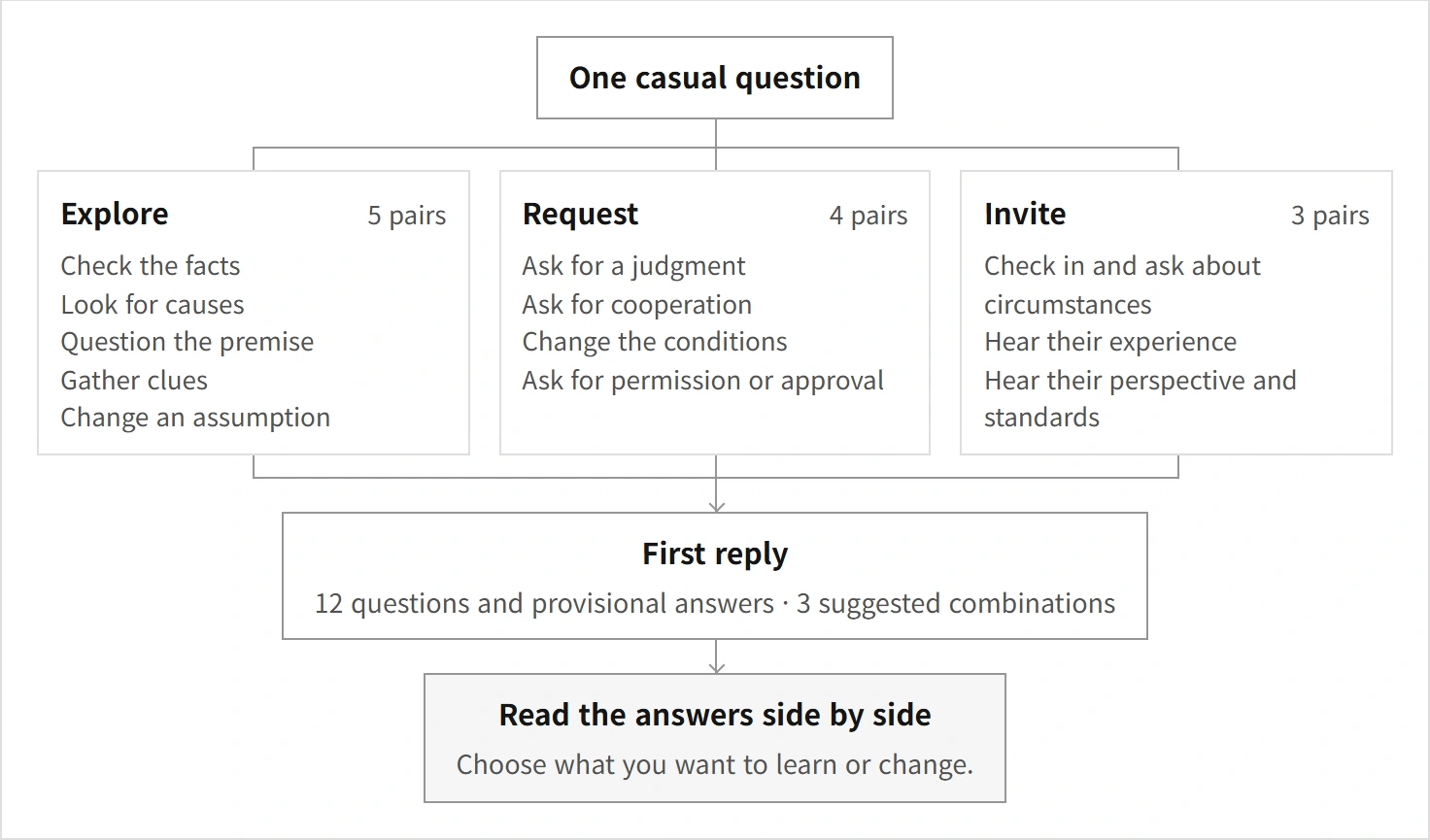
A question on its own leaves you to guess what kind of answer it might produce. I put a provisional answer next to each question. Comparing the answers makes it easier to see what each one would help you decide or do. If one of them raises a question you want to follow, that is where the conversation can go next.
Guide English prompt
Why Is This Person Always Late When We Meet Up?
Ask an AI this and it might respond with “How often has this happened?” or “What kinds of plans are they usually late for?” Those details can help narrow down the explanation. When a question first comes to mind, I do not always know which details to offer.
With Question Expansion, the AI starts working with the sentence it has. It can offer a conditional answer, such as what might explain the delay if the person left late, while their actual circumstances are still unknown.
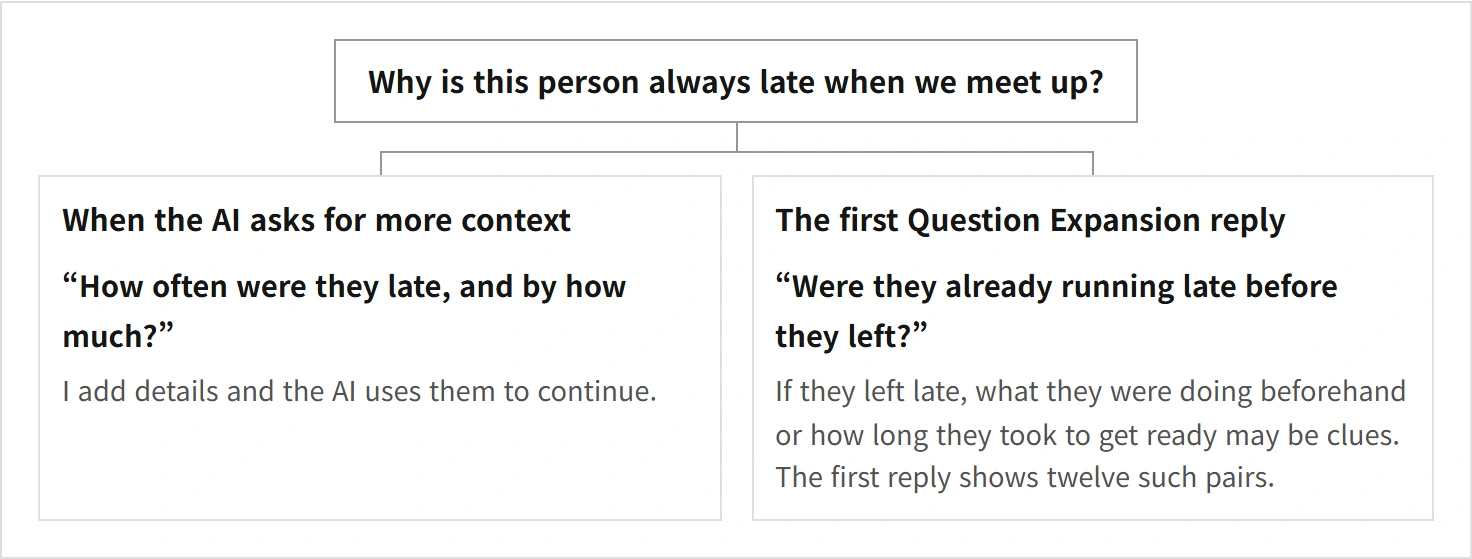
These are the twelve questions and provisional answers from the first reply, with no extra information about how often the person was late or what happened on those occasions.
Branch | Expanded question | Provisional answer |
|---|---|---|
Explore ① Check the facts | How often were they late, and by how much? | Three consecutive delays of 20 minutes would set a different expectation for next time than two five-minute delays across five meetups. |
Explore ② Look for causes | Where did time get lost: getting ready, leaving, or traveling? | If they left late, their earlier commitments or how long they took to get ready may be clues. If they left on time and still arrived late, look at how much travel time they allowed. |
Explore ③ Question the premise | Did “let’s meet at seven” mean the same thing to both people? | One person might have meant seven sharp and the other around seven. If both explicitly agreed on seven sharp, different interpretations are less likely to explain the delay. |
Explore ④ Gather clues | What was different on days they arrived on time? | If they are late mainly when meeting right after work, their previous commitment is a clue. If the pattern holds across different days and places, compare when they started getting ready or left. |
Explore ⑤ Change an assumption | Would leaving 15 minutes earlier make a difference? | If leaving earlier gets them there on time, they may have been allowing too little room for delays. If they cannot realistically leave earlier, you could adjust the meetup time or the commitment immediately before it. |
Request ① Ask for a judgment | How should I interpret the repeated lateness? | Whether they give advance notice, acknowledge the inconvenience, and adjust their plans next time can help you judge how much to count on a punctual arrival. |
Request ② Ask for cooperation | What could we try together next time? | Try sharing an estimated arrival time when you leave. The person waiting knows roughly when to expect the other, and the person traveling can compare their estimate with their actual arrival. |
Request ③ Change the conditions | How could we make plans so we meet on time or spend less time waiting? | If meeting right after work is the issue, you could move the meetup to a later time. If the start time is fixed, as with a movie, agree in advance that whoever arrives first can go in. |
Request ④ Ask for permission or approval | Can I bring up the times I had to wait? | You could ask, “Is now a good time to talk about the last few times I waited?” If they agree, describe what happened and what you would like to do differently next time. |
Invite ① Check in and ask about circumstances | Is something making it hard for them to get there on time lately? | You could ask, “Is there anything I should know when we make plans these days?” If work or caregiving limits their availability for now, look for a time that works for both of you. |
Invite ② Hear their experience | What happened last time between getting ready and arriving? | Hear the sequence in their own words to see where time slipped. What you can change will depend on whether work ran late or the journey took longer than expected. |
Invite ③ Hear their perspective and standards | When do we each consider someone late, and when do we expect a message? | They might think a ten-minute delay is fine, while you would want a heads-up after five. You can agree on an arrival time and a separate point at which to send an update. |
I really thought I wanted to know why this person was late. Looking at the questions alone, I thought “ask for a judgment” was closest to what I meant. Only after reading the answers side by side could I put what I wanted into words.
“What could we do to help this person get there on time?”
What I wanted was something we could try the next time we made plans. If meeting right after work leaves too little time to get ready, we could pick a later time. If they tend to underestimate travel time, we could work out together when they need to leave.
Example Full lateness example
Question Expansion
When I tried this in my own work, the difference was even more noticeable. A different question changes what evidence I look for and which step I try to improve first. “Why is this taking so long?” can lead to “What could we change in the step that takes the most time?”
I put the Question Expansion instructions and examples on GitHub so others can try it. Copy the Korean or English prompt and put one question at the bottom. If your AI tool supports skills or plugins, you can save the prompt as a rule to call when you need it.
The full lateness example includes all twelve question–answer pairs, the intent that emerged after reading them, and three suggested combinations. If you try it, see which answer changes what you want to ask next.
GitHub · ustudiopd/question-expansion · Korean prompt · English prompt · Full lateness example