100 Fun Facts About Project Hail Mary
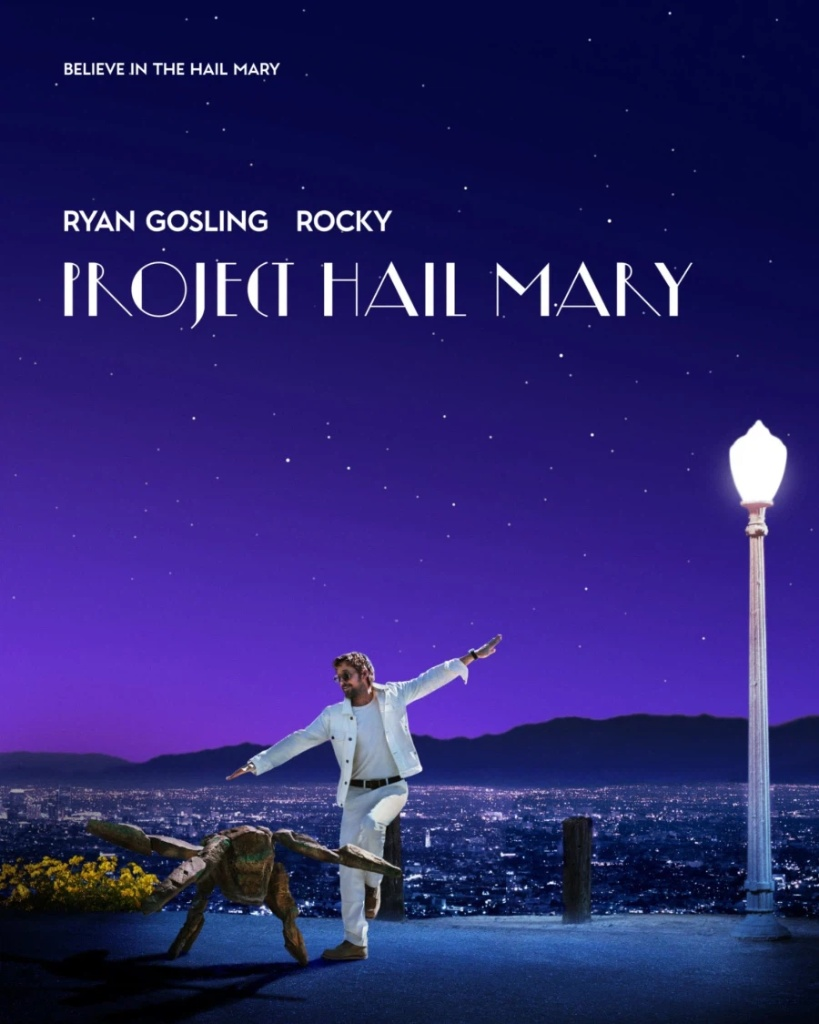
After watching the Project Hail Mary movie, I spent the whole day searching for 35 related reviews on YouTube and compiled 100 behind-the-scenes details from the movie. ChatGPT, Gemini, NotobookLM
1. Planning, Casting, and Directing
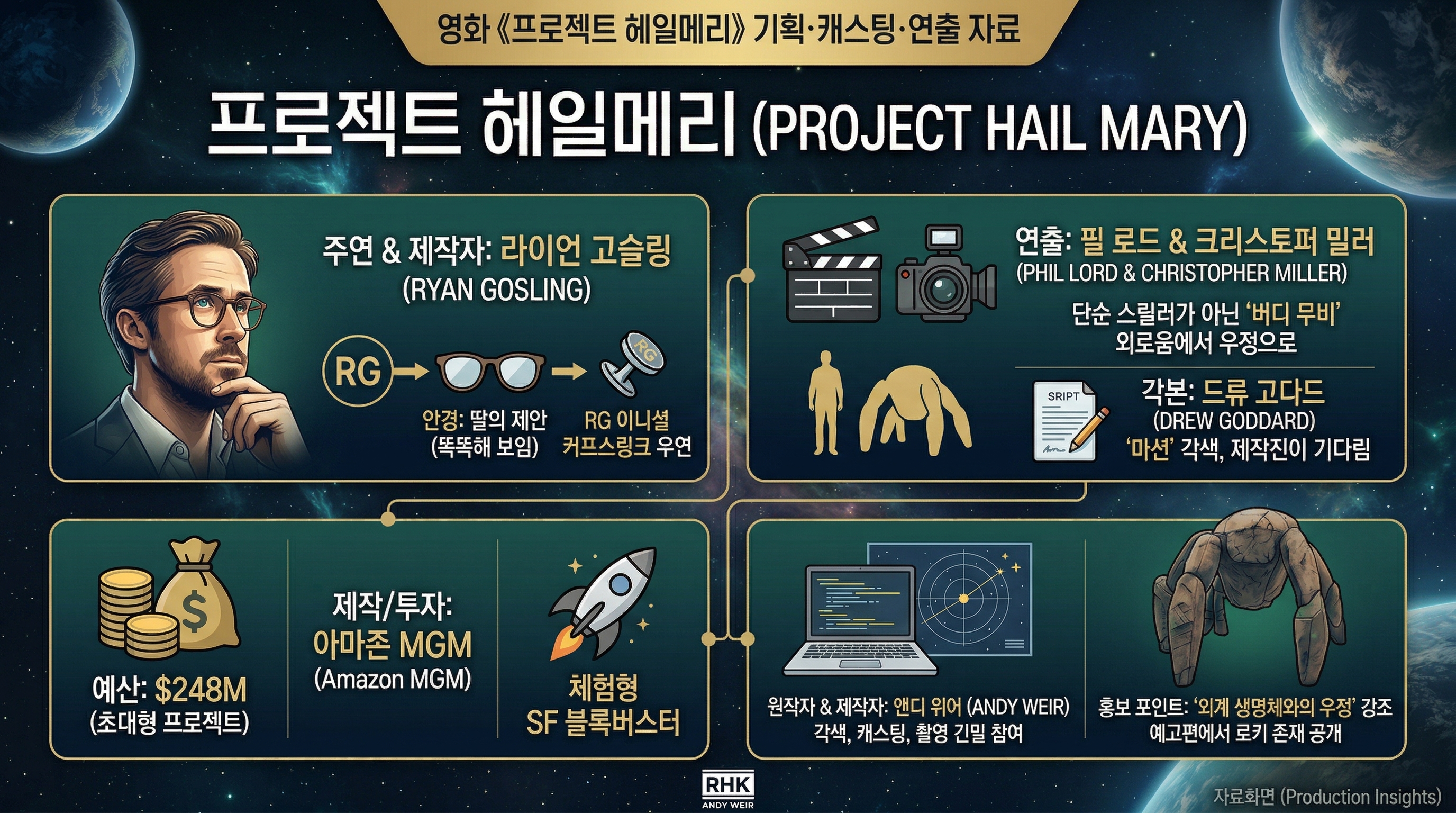
The movie *Project Hail Mary* is a massive project with a budget of approximately $248 million, a prime example of how much Amazon MGM is betting on its original SF blockbuster.
Directors Phil Lord and Christopher Miller defined the project not just as a survival thriller, but asa story of loneliness turning into friendship,and set their direction accordingly.
The screenplay was written by Drew Goddard, who also adapted *The Martian*. The anecdote that the production team waited for him instead of replacing him with another screenwriter shows how much this project was driven by the screenwriter.
Ryan Gosling was strongly drawn to this project from the early stages, before the original work was fully known to the world, and he moved proactively from the beginning, even seeking to secure the rights himself.
Gosling was not just an actor in the film but also credited as a producer, functioning as a key figure who had a real impact on the film's initial direction and atmosphere.
The fact that both actor Ryan Gosling and the main character Ryland Grace share the initialsRGis often mentioned as a meta point enjoyed by the production team and the original author.
Andy Weir joked with Gosling about this coincidence, saying, "You can just wear your initial cufflinks," which also means that the character and the actor's image matched naturally.
The setting of Grace wearing glasses was not fixed from the beginning, but was adopted after Gosling's daughter said at a costume test, "Dad looks smarter."
The production team meticulously adjusted the character's tone to make Grace appear less as a skilled space hero from the start, but rather assomeone who is fearful and clumsy but ultimately chooses responsibility.to make him appear as.
This project is quite a symbolic case industrially, as it was promoted from the MGM era and continued even after the studio system changed.
Andy Weir is known to have participated in this film not just as the author who provided the original work, but as a producer, closely observing casting, filming, and post-production.
Weir said that he did not have a film adaptation in mind when he wrote the original work, but as a result, the clear structure of scientific puzzles and character relationships made it a filmable work.
Phil Lord and Christopher Miller repeatedly described this film as a "buddy movie set in space," which clearly shows that the identity of this work is closer to a relationship drama than a disaster film.
Therefore, the trailer was designed not to hide the existence of Rocky until the end, but rather to reveal first that this film has the core appeal of 'friendship with an alien life form.'
From the initial promotion, the positioning of this work as "a movie that must be seen on a big screen" was strongly intended by the production team to have it consumed not only as a story but also as an experiential blockbuster.
2. Filming, Format, Set, VFX
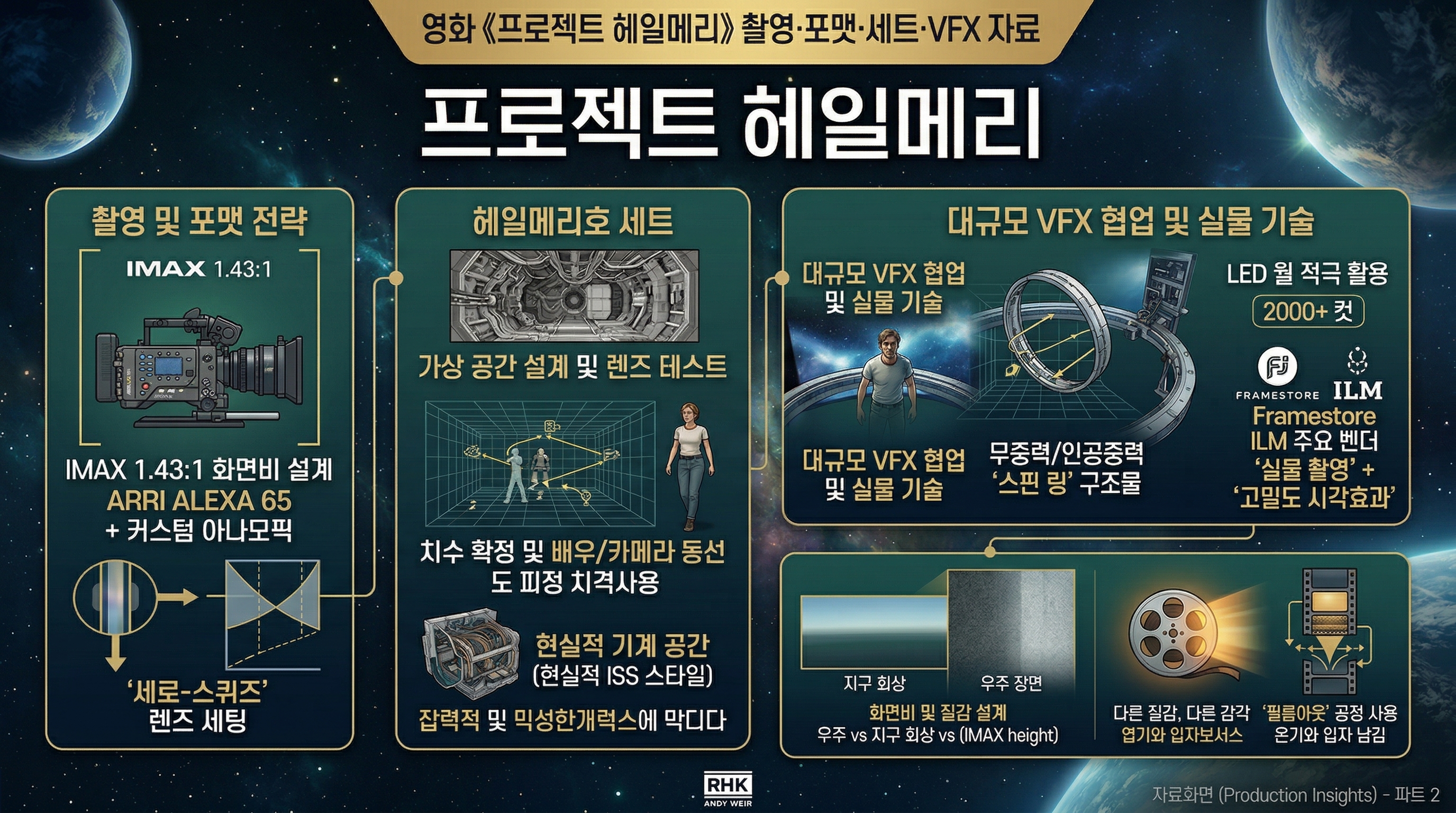
*Project Hail Mary* was strongly designed with the IMAX 1.43:1 aspect ratio in mind, and the directors wanted the film to work best on a vertically large screen from the beginning.
However, the figure "IMAX 1.43 screen is exactly 117 minutes," which is widely spread among fans, is difficult to see as confirmed information based on currently released official data alone.
ARRI ALEXA 65 and a custom anamorphic system were used for filming, and a unique setting was developed to mount the lens sideways, especially to maximize the height of IMAX.
The so-calledvertical-squeeze anamorphicmethod was a solution devised to maximize the vertical sense of space in IMAX, rather than the usual wide screen, which also means that the format strategy for this film was meticulous.
The ship set was designed first in virtual space before filming and the dimensions were confirmed after lens testing, so that the actors' movements and camera movements were intertwined like a single physical system from the beginning.
The interior of the Hail Mary was designed not as a sleek, Apple-like future space, but as a realistic mechanical space with exposed wiring and equipment, like the International Space Station.
The reason for actively using the LED wall was not simply to synthesize the background beautifully, but to make the light source outside the spaceship actually reflect on the actor's face and the surface of the set.
Thanks to this, the interior of the spaceship in this film has a texture that feels more like a space where light and reflection have already been calculated on set, rather than "a screen with a background added later."
The statement "We never used a green screen" is strictly closer to meaningavoided blue and green chroma key backgrounds,and does not mean that CG or visual effects themselves were hardly used.
In fact, according to publicly available technical data, the entire film contains over 2,000 VFX shots, and the expression of outer space and external ships was completed with large-scale digital work.
Since Framestore alone was responsible for around 1,100 VFX cuts, it is more accurate to see this film as having both characteristics of being 'focused on real-life filming' and 'high-density visual effects film.'
ILM also participated as a major VFX vendor to reinforce the external space environment and large-scale scenes, and as a result, this film became a collaborative blockbuster made by several top-notch technology companies.
Actual spin ring structures were used for zero-gravity and artificial gravity scenes, and thanks to the method of having the actor physically endure by placing them on a rotating structure, the change in the body's center of gravity appears more convincing.
The space scenes and Earth flashback scenes were designed not only with different aspect ratios, but also with different textures and grains, so that the audience unconsciously perceives the two worlds with different senses.
The 'film-out' process of outputting digital shooting images back to film to add texture was also used, which was a choice to avoid making the screen too cold and leave some warmth and particles.
3. Lighting, On-Set Acting, Improv Behind the Scenes
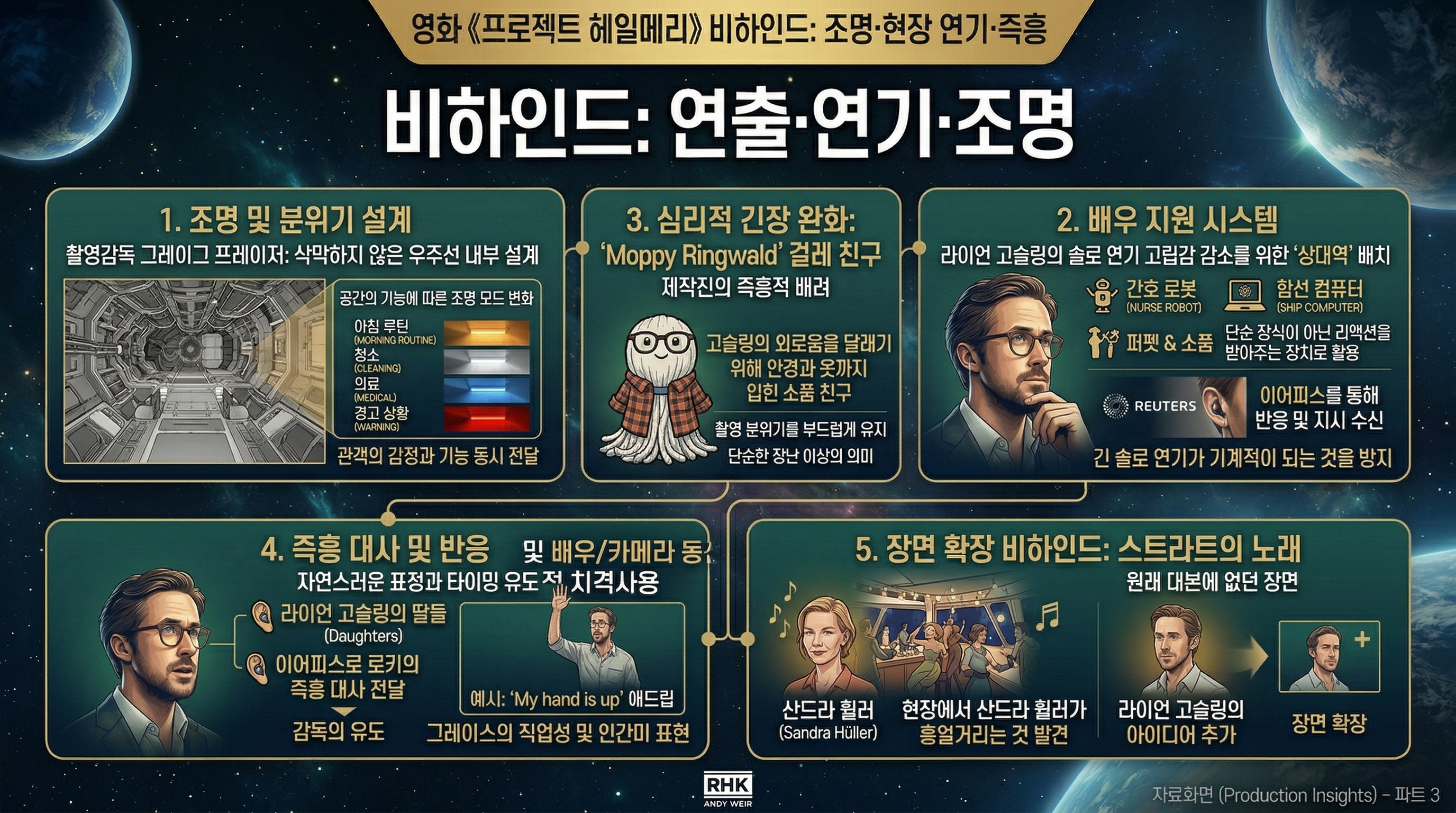
Cinematographer Greig Fraser explained that he designed the lighting modes and colors differently according to the function of each space so that the interior of the spaceship would not look too dark and bleak.
Therefore, spaces such as capsules or cockpits have different lighting colors depending on the morning routine, cleaning, medical, and warning situations, even in the same location, and the audience reads emotions and functions through this at the same time.
The directors said that because the lead had to lead most of the film alone, they tried to have as many 'co-stars' as possible on the set for Gosling to react to.
Nurse robots, ship computers, puppets, and even small props were used not just as simple decorations, but as devices to reduce the actor's sense of isolation and receive reactions.
According to a Reuters report, Gosling acted in some scenes while receiving reactions and instructions through an earpiece, which was a way to prevent long solo performances from becoming too mechanical.
The most famous of the on-set anecdotes is a mop friend named 'Moppy Ringwald', the story that the production team made a prop friend with glasses and clothes to relieve Gosling's loneliness.
This mop friend episode sounds like a simple prank, but it is significant in that it was an impromptu consideration by the production team to relieve the actor's psychological tension and maintain a smooth filming atmosphere.
Gosling's daughters also put Rocky's impromptu lines into the earpiece on set, and the director said that these playful reactions helped draw out the actor's natural expressions and timing.
Some lines with a teacher-like feel, such as "My hand is up," are known to be Gosling's ad-libs, and function as lines that reveal Grace's professionalism and human side in an instant.
The scene where Stratt sings at the onboard party was not originally in the script, but it is said that the scene was expanded as Gosling added ideas after seeing Sandra Hüller humming on set.
4. Music, Promotion, Distribution

The selection of Harry Styles' 'Sign of the Times' for that song is accepted as it was a song that could simultaneously capture the atmosphere of a world collapsing and the strange calmness of the characters.
The film's music was composed by Daniel Pemberton, and the production team explained that they wanted to make it feel like "a mixtape of the entire Earth cheering for the main character."
Pemberton did not just go with a traditional orchestra, but mixed unusual instruments from various cultures and the texture of a boys' choir, approaching it in a direction that strangely leaves a human emotion even though it is a space movie.
The Korean production report also explains that he referenced Steve Reich-style repetitive structures and the rhythm of everyday sounds, showing that the music itself contains both scientific rhythm and emotional pulse.
The titles of the released score tracks directly reflect scientific concepts in the work, such as 'Centrifuge' and 'Petrova Line', so the keywords of the world view are naturally revealed just by looking at the OST.
Amazon conducted early screenings of premium formats for Prime members before the release, which was an event that simultaneously revealed confidence in the work and format marketing.
In the promotion process, various viewing formats such as IMAX, Dolby, 4DX, 70mm, and ScreenX were put to the fore, and even videos of the directors directly experiencing and explaining each format were distributed.
Amazon sold limited Kindle covers and linked goods such as Echo Pop to coincide with the film's release, marketing this work by expanding it not just as a simple movie but as a platform event.
5. Rocky's Production Behind the Scenes

Rocky is commonly known as a 'real animatronics alien', but based on official technical data, it is most accurate to see it as a hybrid character combining puppet and CG.
Nevertheless, the important point is that an actual puppet existed on set, so the actor was able to act with a being that had real volume and timing, rather than an empty space or a tennis ball.
Five professional pilots were needed to move the Rocky puppet, and the fact that this team was called 'Rocketeers' on set shows how complex the performance of this character was.
James Ortiz is a puppeteer who was in charge of Rocky's movements and on-set voice, and he created a significant portion of the character's emotions in real time through his chemistry with Gosling.
Initially, there was an option to re-dub with the voice of a famous actor in post-production, but because the on-set chemistry was so good, the direction was chosen to maximize Ortiz's performance.
It is known that the selection of puppet operators included not only simple technical tests but also a 'chemistry read' to confirm chemistry with the actor, which shows that Rocky was treated virtually as a co-star.
The directors judged that Gosling's loneliness would be reduced and his reactions would come to life if Rocky was always on set, so they chose a filming method that maintained a real-life presence as much as possible.
Thanks to this choice, Rocky was completed not just as a visually amazing alien, but as an 'acting partner' that the other actor could give a real emotional reaction to.
According to some reports, Meryl Streep participated in some of Rocky's related voices as an uncredited cameo, which is known as a surprise element from the production team's connections.
6. Rocky and Eridian Species Settings

The Eridian language is not a language centered on a single voice like humans, but has a chord structure in which multiple tones are stacked simultaneously, giving the impression of a completely different intelligence from the beginning.
The principle by which human machines translate this chord language is explained as a method of decomposing multiple frequencies and reconstructing meaning, and Fourier transform thinking is used as the basis in the work.
Rocky's habit of repeating words three times when expressing emotions is not just a cute feature, but a device that gently shows that the language system and emotional expression method are different from humans.
Rocky is a being with five legs, but because he perceives the world with six reference points including the torso, he is naturally set to have achieved a base-6 civilization rather than the human decimal system.
Because Eridians evolved in an environment where little light reaches, they have no eyes and instead perceive their surroundings with sonic senses close to echolocation.
This sense is set not just at the level of 'seeing even in the dark', but in the direction of reading the structure of objects three-dimensionally, forming a completely different worldview from human visual-centered perception.
The Eridian mother environment is set to have much higher pressure and temperature than Earth, making it an interesting contrast that a planet like hell is the starting point of civilization for them.
Because their atmosphere is so thick, cosmic radiation is naturally blocked, and as a result, the setting is that Eridians have not developed radioactivity itself as an everyday scientific concept.
This ignorance became a fatal weakness when they started space exploration, and the background that Rocky's colleagues who were with him fell ill due to radiation problems greatly enhances the character's tragedy.
The setting that the reason why only Rocky survived was because he was an engineer working near the Astrophage fuel tank is a hard SF-style irony that cleverly overlaps coincidence and science.
Because Eridians are a much longer-lived species than humans, their sense of time itself is different, and the fact that Rocky was able to continue his research alone for many years is also linked to this long life cycle.
The fact that they have a sleeping culture in which someone has to watch over them to feel safe and fall asleep because they become almost defenseless as if their consciousness is paralyzed when they fall asleep is a unique setting that gives a glimpse into the living norms of Eridian society.
The cultural setting that they consider it shameful to show eating or excretion to others shows a completely different etiquette system from humans, and the film flexibly transforms and uses this with the emotion of a buddy comedy.
7. Eridian Biology and Civilization Logic
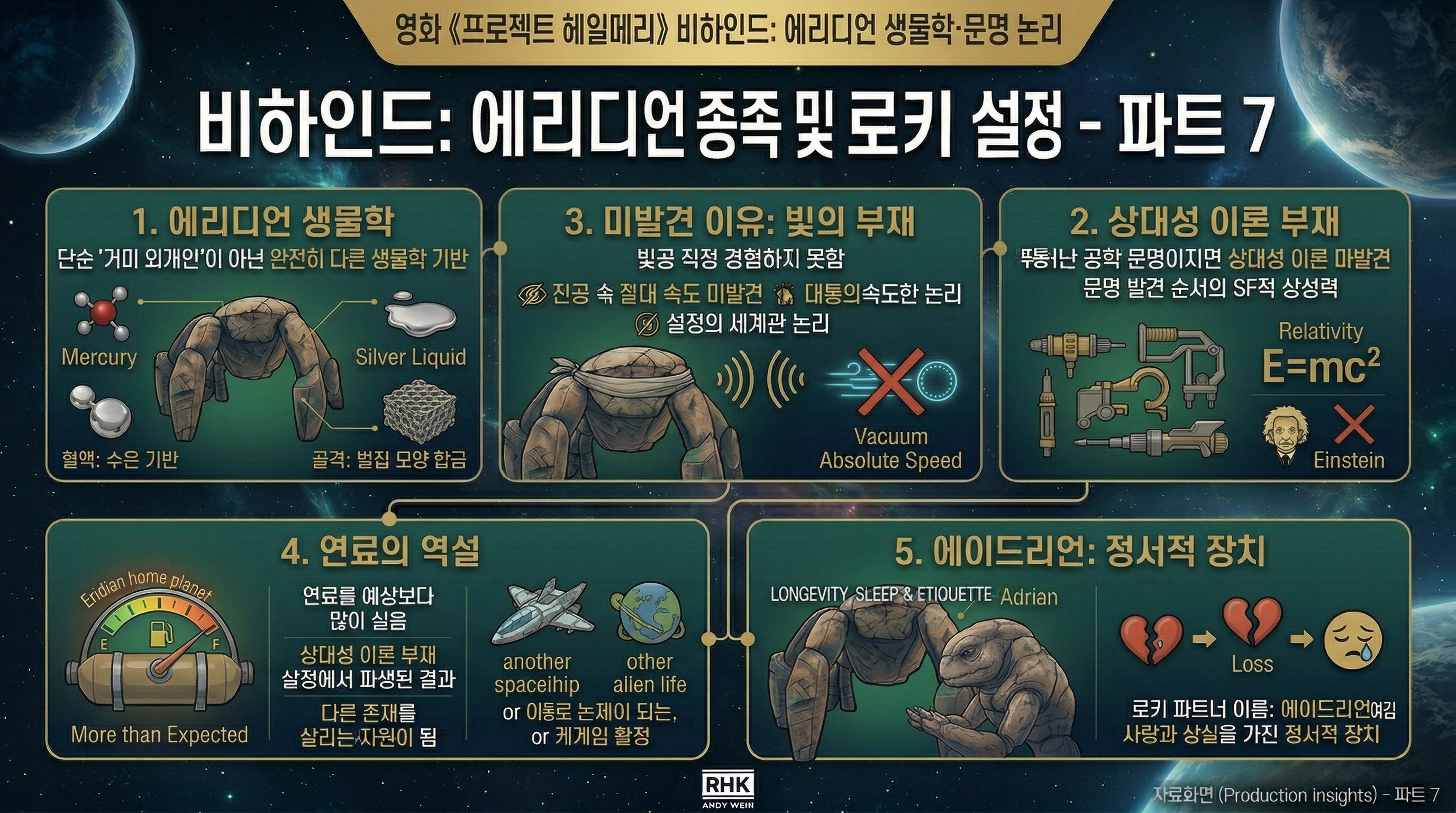
The setting that Eridian blood is mercury-based and the skeleton is a honeycomb-shaped alloy structure emphasizes that this species is not simply a 'spider-like alien' but a being with a completely different biological basis from humans.
The setting that they created an excellent engineering civilization but did not discover the theory of relativity well shows the SF imagination that the development of civilization does not necessarily have to be in the same order as humans.
The work explains the reason as 'they could not directly experience light and did not discover the absolute speed that moves constantly in a vacuum', persuading the setting with a world view logic.
The idea that Rocky brought more fuel than expected and that it becomes a resource that saves other beings is also interesting in that it is ultimately a result derived from this absence of the theory of relativity setting.
The small detail that Rocky's partner's name is set as Adrian is an emotional device that makes Rocky feel not just like a genius engineer but like a being with love and loss.
8. Andy Weir, NASA, and Scientific Consultation
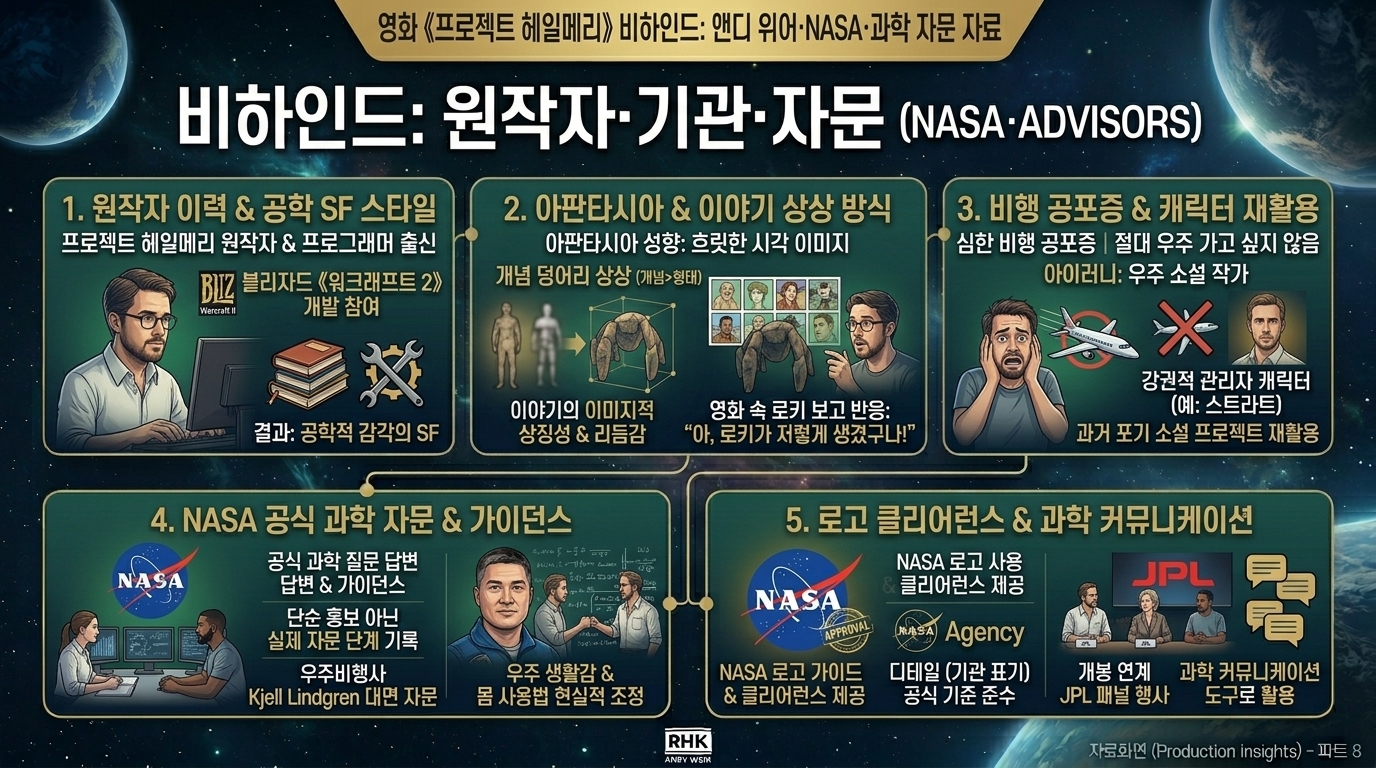
Andy Weir is originally a programmer and has experience participating in the development of *Warcraft 2* at Blizzard, which is often cited as the background for his SF having an engineer-like sense.
There is an interpretation that he dreamed of becoming a cartoonist before becoming a novelist, and that the strong image symbolism and rhythm of the story are not unrelated to this history.
Weir revealed that he does not tend to conjure up vivid visual images in his head due to his aphantasia tendencies, so he said that he imagined Rocky as a 'concept chunk' rather than a specific form first.
The anecdote of reacting by saying "Ah, that's what Rocky looks like" after seeing the actual Rocky in the movie well shows that the original author's imagination was closer to structure and logic than form.
Ironically, he has a severe fear of flying, and it is often a topic that a person who does not want to go to space at all, rather than someone who wants to go to space directly, wrote a space novel.
It is also known that Stratt-like coercive manager characters and some settings are ideas that Weir recycled from other novel projects that he gave up on in the past.
NASA officially stated that it answered scientific questions and provided overall guidance during the production of this film, recording that there was an actual advisory stage rather than simple promotional collaboration.
NASA stated that there was a face-to-face consultation between astronaut Kjell Lindgren and the actors, which was a process to realistically adjust the use of the body and sense of life in outer space.
NASA even provided the necessary guidance and clearance for the use of the NASA logo in the film, helping to ensure that details such as institutional notation conformed to official standards.
The fact that a related panel event was held at JPL in connection with the release and that NASA left this as an official record shows that this work was treated not just as a simple entertainment film but also as a tool for science communication.
9. Science, Math, and Engineering Details
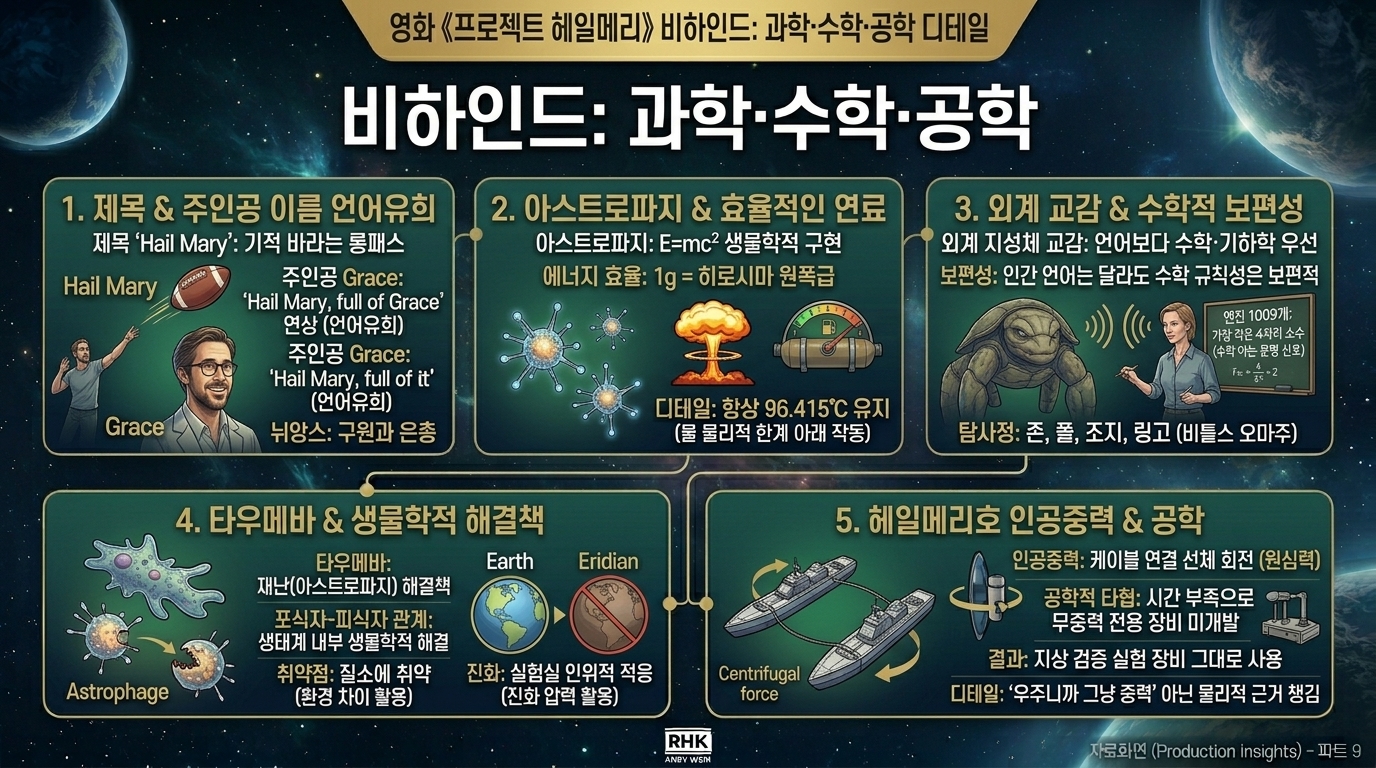
The title 'Hail Mary' refers to an almost gambling-like long pass thrown in American football in the hope of a miracle at the end of the game, so the project name itself already contains the meaning of a desperate last resort.
Here, the name of the main character, Grace, overlaps, creating a play on words that evokes 'Hail Mary, full of Grace', naturally adding a nuance of salvation and grace to the entire work.
Astrophage is set as if it biologically implements E=mc², and the idea that a living organism extremely utilizes mass-energy conversion is the core SF device of this work itself.
The explanation that 1g of Astrophage is equivalent to the energy of the Hiroshima atomic bomb functions to make people understand at once how unrealistically efficient this creature is as a fuel, rather than just a number.
The setting that it always maintains 96.415℃ is not just a cool number, but a detail that contains a scientific hint that this creature operates within the physical limits related to water.
The reason why Grace uses argon gas in the experiment is because it is a non-reactive inert gas, and this choice is a small point that enhances the scientific persuasiveness of the overall work.
The method of using mathematics and geometry first when communicating with alien intelligence for the first time is a scene that inherits the hard SF tradition that mathematical regularity can be universal even if human languages are different.
The setting of matching the number of spaceship engines to 1009 is also explained as an intention to send the signal "We are a civilization that knows mathematics" by using the fact that 1009 is the smallest four-digit prime number.
Naming the unmanned probes John, Paul, George, and Ringo is an homage to the Beatles, and it can be said to be a way of planting human humor and pop culture sense even in extreme science stories.
The structure of using Taumeeba as a solution is quite a biological SF idea in that it solves the disaster with the predator-prey relationship inside the ecosystem instead of solving it with a bigger weapon.
The setting that Taumeeba is vulnerable to nitrogen is a device that utilizes the environmental differences between Earth and Eridian at the same time, so that the scientific puzzle works like a drama of environmental differences rather than a simple memorization-type setting.
The process of artificially evolving Taumeeba by repeating generations in a closed environment to adapt it to nitrogen is a representative example of hard SF imagination that deals with evolutionary pressure on a laboratory scale.
The artificial gravity of the Hail Mary is implemented by the principle of centrifugal force that connects the two hulls with cables and rotates them, which is the result of taking care of the physical reason to the end without using the convenience of 'just gravity because it's space'.
The reason why the work specifically creates artificial gravity is also explained as because there is no time to develop new equipment exclusively for zero gravity, so the experimental equipment verified on the ground is used as is in space.
In the end, the most impressive detail of *Project Hail Mary* is that it meticulously built a miraculous story of space friendship on top of actual engineering, biology, language design, shooting technology, and on-site performance.