Stuck Paying for Photoshop and CAD—Can AI Change That?
When we switch apps, can we take the skills we already know with us?
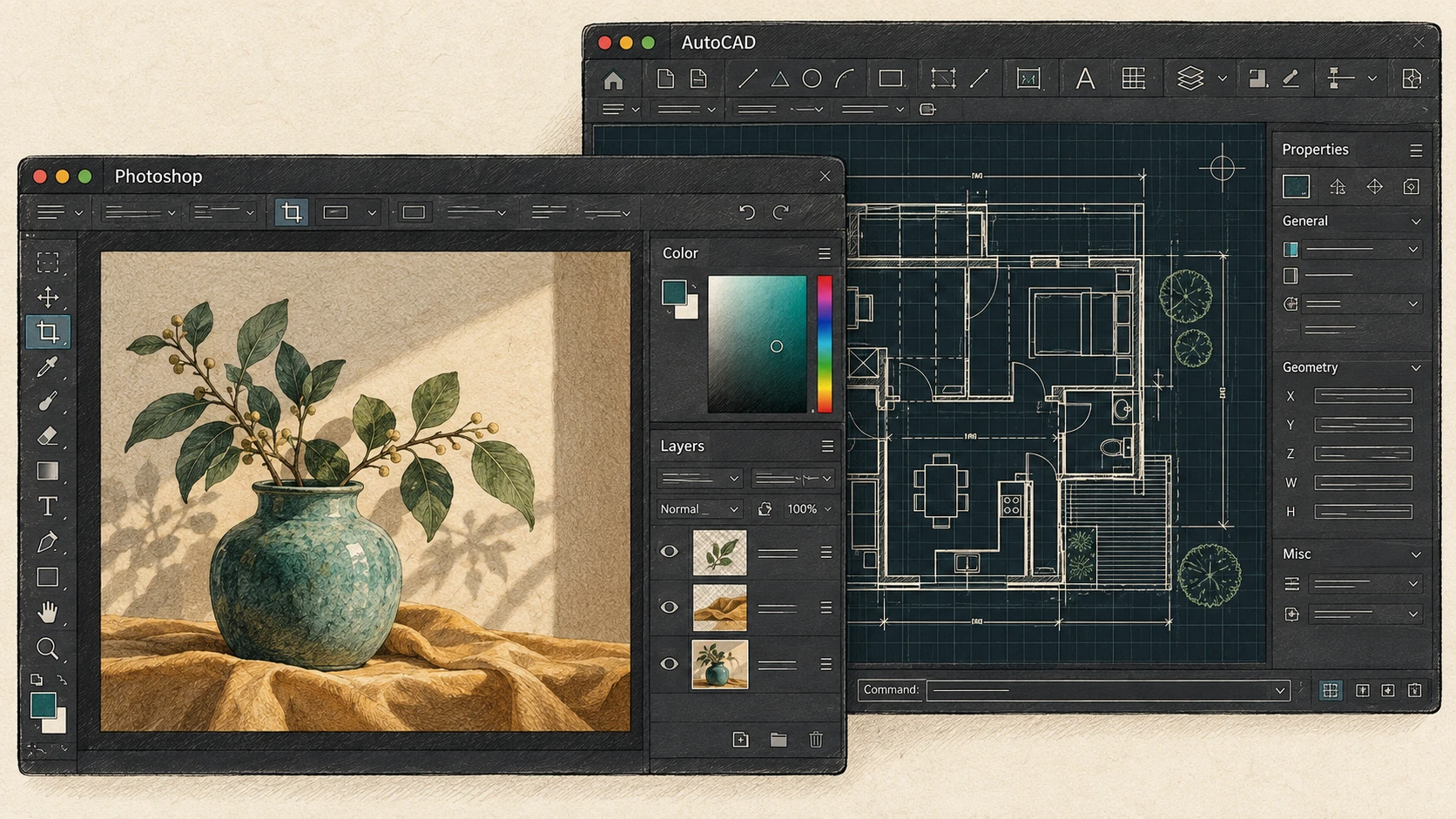
An AI illustration inspired by familiar Photoshop and AutoCAD workspaces. These are not actual screenshots.
Picture the moment a subscription renewal notice arrives. Perhaps this time you will try another program. You search for free alternatives, but there is a file you need to revise and send tomorrow. Instead of learning a new set of menus, you open Photoshop and type the CAD commands you know by heart. The work gets done. The subscription continues.
That helps explain the interest in AI-built apps that resemble Photoshop and CAD software. Free alternatives already existed. The new possibility is being able to choose another provider while keeping the skills you have spent years learning and the files you have accumulated. Beside the price of an app sits another cost that never appears on its pricing page: the cost of switching.
1. A free app still takes time to learn
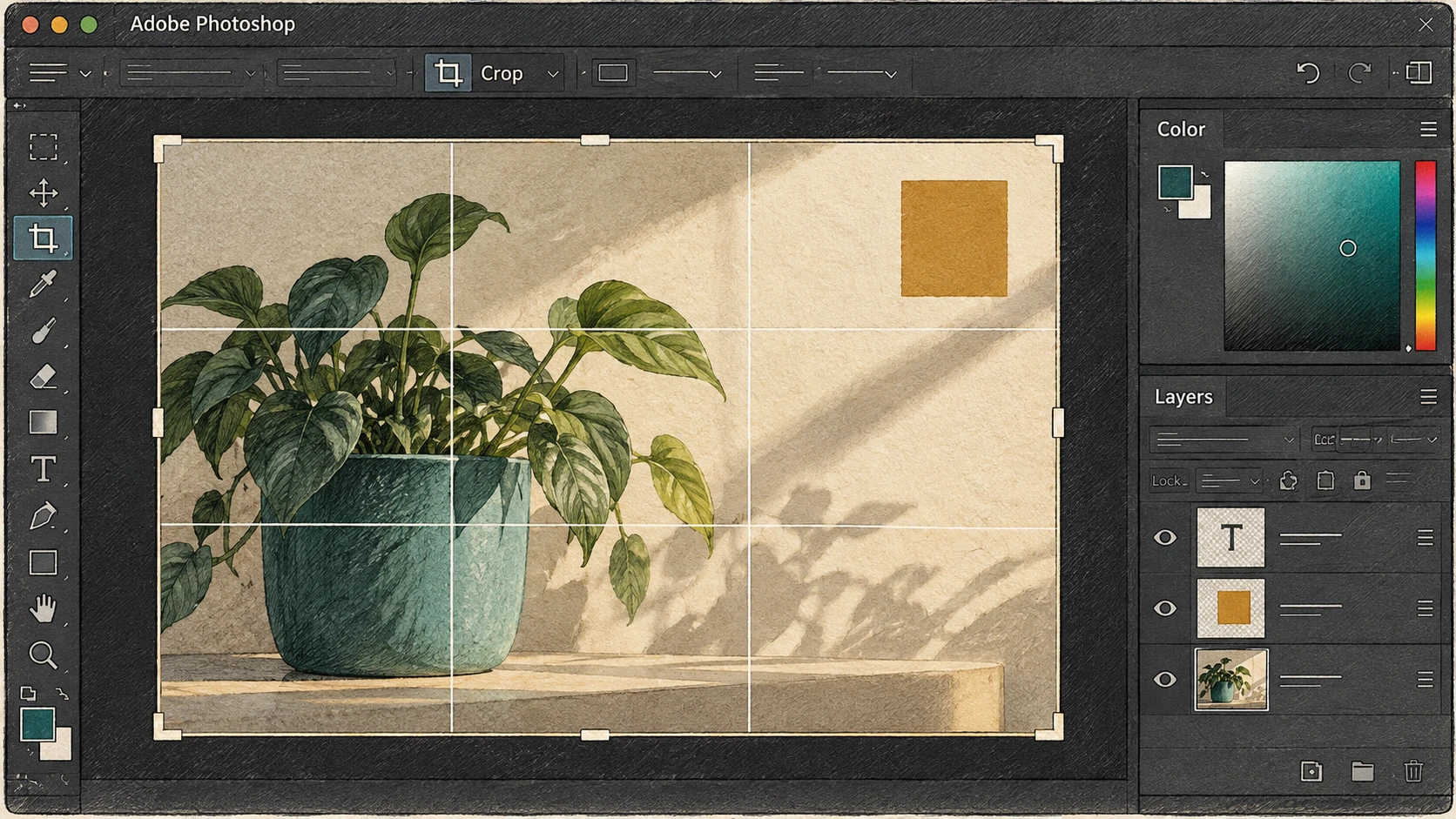
Familiar tool positions and working habits also influence which app we choose. An AI illustration inspired by Photoshop's interface.
Many apps can remove a background, edit text, or save an image at the right size. That does not mean you can finish those tasks equally quickly in all of them. Shortcuts you use without thinking in Photoshop may need to be looked up one by one. You may have to learn a different sequence of steps.
CAD work comes with even more habits: drawing commands, frequently used drawing elements, line weights, print settings, and files from collaborators. They are all part of how the work gets done. Changing programs means checking steps that used to pass without a second thought.
Keeping a subscription under these circumstances is hardly just stubbornness. Time spent learning a tool costs money. So does time spent fixing a problem just before delivery. Some people also keep using their current app because it does its job well. Finding the price burdensome and deciding to keep paying can both make sense.
A free alternative therefore needs to answer an extra question. Alongside what it can do, we need to ask how much of our existing work we must learn to do again. When that burden is high, a price tag of zero does not automatically mean a saving.
Sources: Reddit r/foss — Existing open-source projects and AI app clones · CADCraft official product page
The discussion of relearning costs is an interpretation of public debate and CAD workflows. The opening scene and work examples are illustrative, not customer interviews.
2. Why build another app when GIMP already exists?
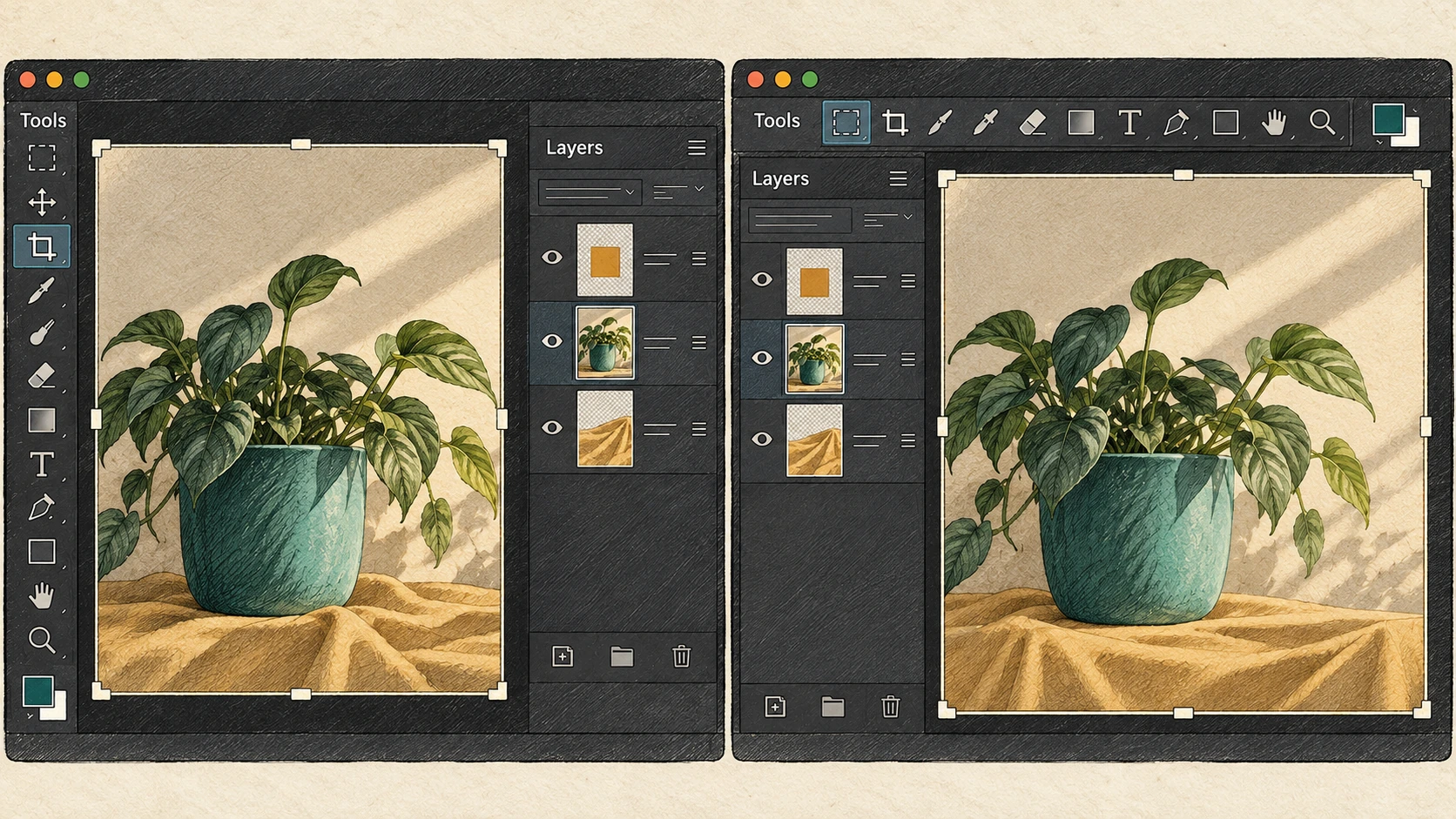
Two apps may produce the same result while asking your hands to follow different steps. An AI illustration of two imagined editing interfaces.
In a Reddit open-source discussion about ArtCraft, one criticism was straightforward: if free editing software already exists, why not contribute the money and effort to those projects instead of building more clones? Some commenters also resented the attention given to AI-built apps while developers who had contributed for years were overlooked.
Others countered that the existing alternatives did not work the way Photoshop does. Even when an app produces the same result, different button positions and controls can make switching difficult. These comments do not represent every user. They do, however, point to a need that the phrase 'there is a free tool for that' does not resolve.
GIMP's own explanation makes the difference clearer. It says its goal is not to defeat Photoshop, and that it improves workflows through user research and its own design process. It prefers that approach to copying another app's interface. Programs developed around their own goals cannot reasonably be called failures simply because they look or work differently.
Yet for someone already fluent in Photoshop, even a good new design is something else to learn. While developers propose a better way to work, users may be looking for somewhere to keep working the way they already know. Part of the excitement around clones comes from that gap: people want to put their existing skills to immediate use in another app.
Sources: Reddit r/foss — Existing open-source projects and AI app clones · GIMP official FAQ — Development goals and interface design
Reddit arguments on both sides are paraphrased. GIMP's development goals were checked against its official FAQ. Commenters' feature complaints and personal attacks are not treated as product evaluations.
3. AI clones are trying to reproduce familiar ways of working
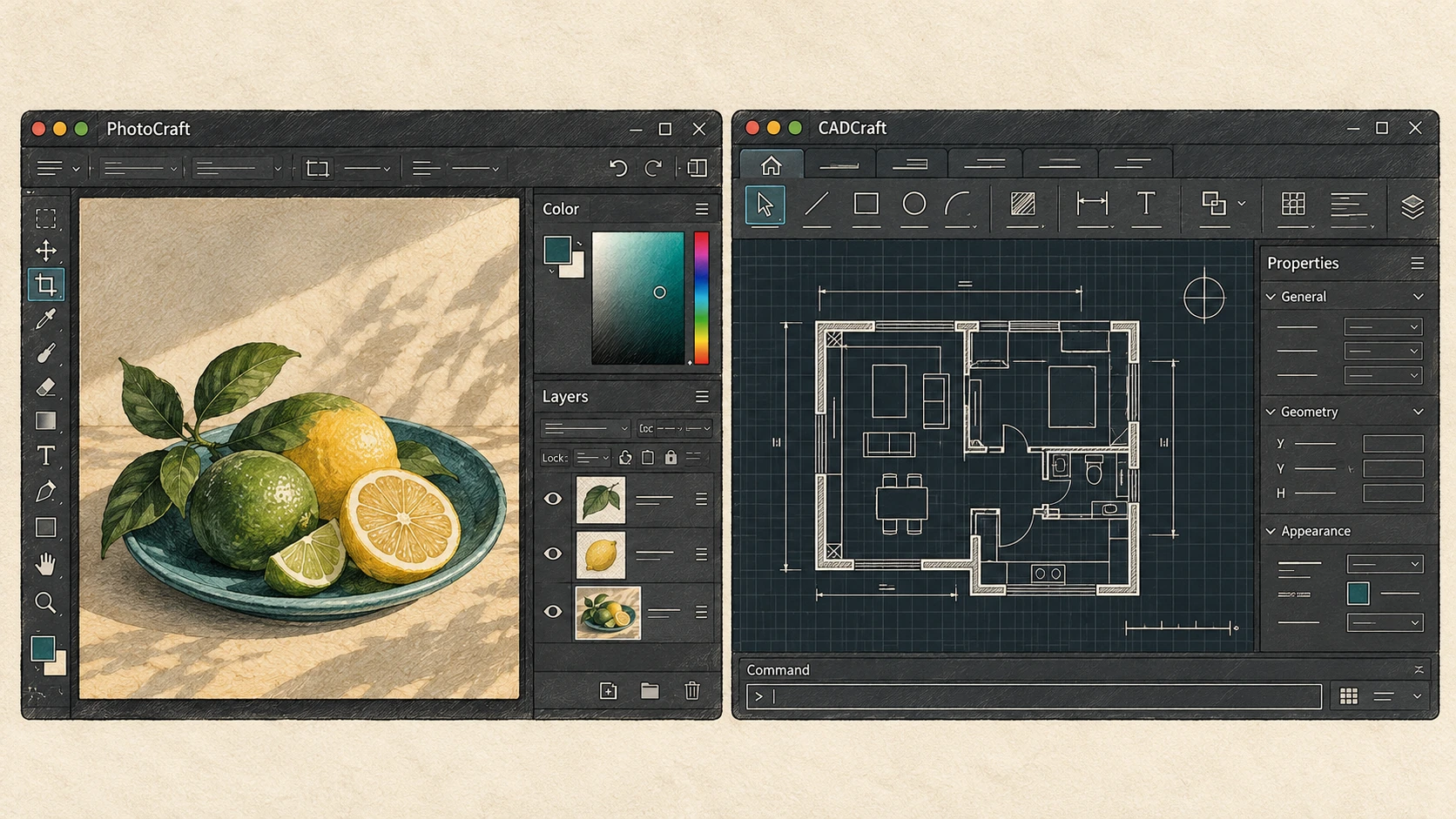
An AI illustration conceptually reconstructing PhotoCraft and CADCraft workspaces. It does not imply feature parity with the original products.
ArtCraft's official description of PhotoCraft emphasizes familiar menus, shortcuts, and panels. CADCraft likewise describes a recognizable workflow: enter commands, select points, and work with lines and drawing elements. The same team lists 13 apps spanning photo editing, documents, presentations, and CAD. Most are in early testing or still in development.
AI is being used for this kind of reconstruction with a clearly defined target. CADCraft's public development notes document the initial AI implementation alongside bugs found later and work still to be done. An existing app provides a reference for which features to build and how they should behave. That is a different starting point from discovering users' needs and designing a product from scratch.
For users, the interesting possibility is that familiarity could become portable. The more skilled you became with one app, the more disruptive a move to another could be. If a new app reproduces its controls well enough, years of practice could remain useful in a different tool. You could change providers without discarding what you have learned.
Similar screens do not, of course, guarantee identical behavior. Some users report awkward brush or cursor movement; others reply that these are early versions that need more time. What we can currently see is an attempt to reproduce familiar controls. How smoothly people can switch has to be judged through actual work.
Sources: ArtCraft official app catalog · PhotoCraft official product page · CADCraft official product page · CADCraft development notes — AutoCAD parity and remaining work · Reddit r/ArtCraftAI — PhotoCraft complaints and the early-version debate
Feature descriptions come from the maker, not an independent performance evaluation. The maker's completion estimates and cumulative AI work hours are not presented as the total time required to develop a finished product.
4. Familiar shortcuts do not solve file compatibility
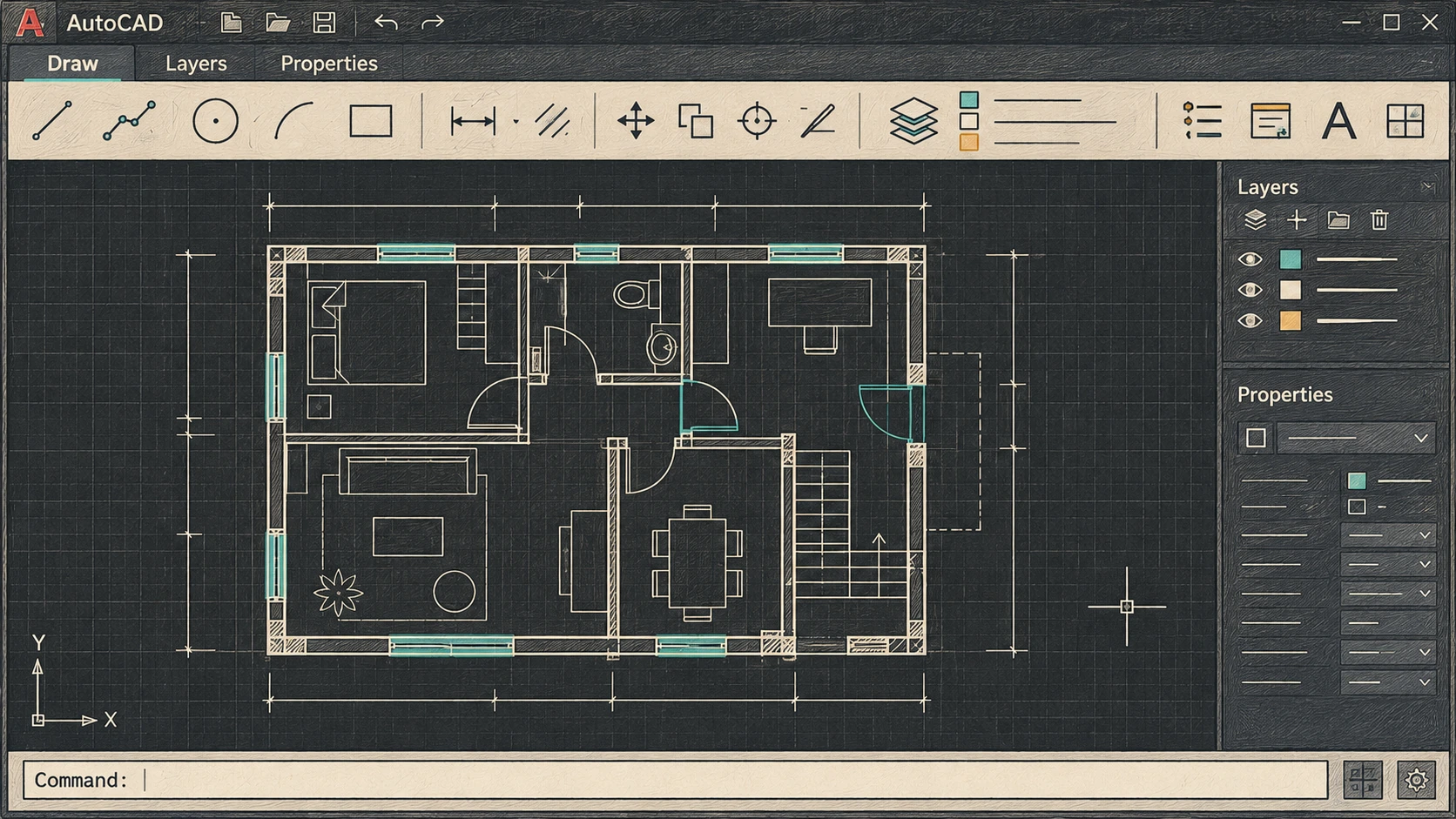
Drawings move between different people's tools as they are revised. An AI illustration inspired by an AutoCAD workspace.
Suppose your shortcuts work perfectly in the new app. You still need to open old files, edit them, save them, and send them to a client. Do text and layers remain intact? Are drawing dimensions and external references preserved? Can the recipient keep editing? The move is not complete until those questions are answered.
PhotoCraft's development history illustrates the distinction. On October 17, a user reported that changing text in a particular PSD file and saving it caused Photoshop to crash when reopening the file. A subsequent fix includes a record of reopening and testing that file in Photoshop. This is evidence neither that every file breaks nor that every compatibility problem has now been solved.
CADCraft's official description also distinguishes between drawing formats. It lists reading and writing for DXF, and opening for DWG. A brief claim of 'CAD file support' is not enough to establish that you can edit an incoming file and reliably send it back in the same format.
At this point, one person's choice becomes tied to other people's work. If you can draw comfortably in a new tool but a collaborator must repair the result, your saving may turn into their extra hours. Teams that share drawing elements and review procedures cannot necessarily move just because one person is satisfied.
Clone apps therefore face several layers of switching costs: relearning controls, moving old files, and exchanging work with others. As they get better at reproducing the screen, the next test becomes how well real files survive the journey.
Sources: PhotoCraft issue #6968 — PSD reopening failure after a text edit · PhotoCraft pull request #7220 — Fix and Photoshop retest · CADCraft official product page
The PhotoCraft example includes both the bug report and the retest after the fix. CADCraft's format support reflects its official description on October 25, 2026; this article did not test production files.
5. Free apps can still support profitable companies
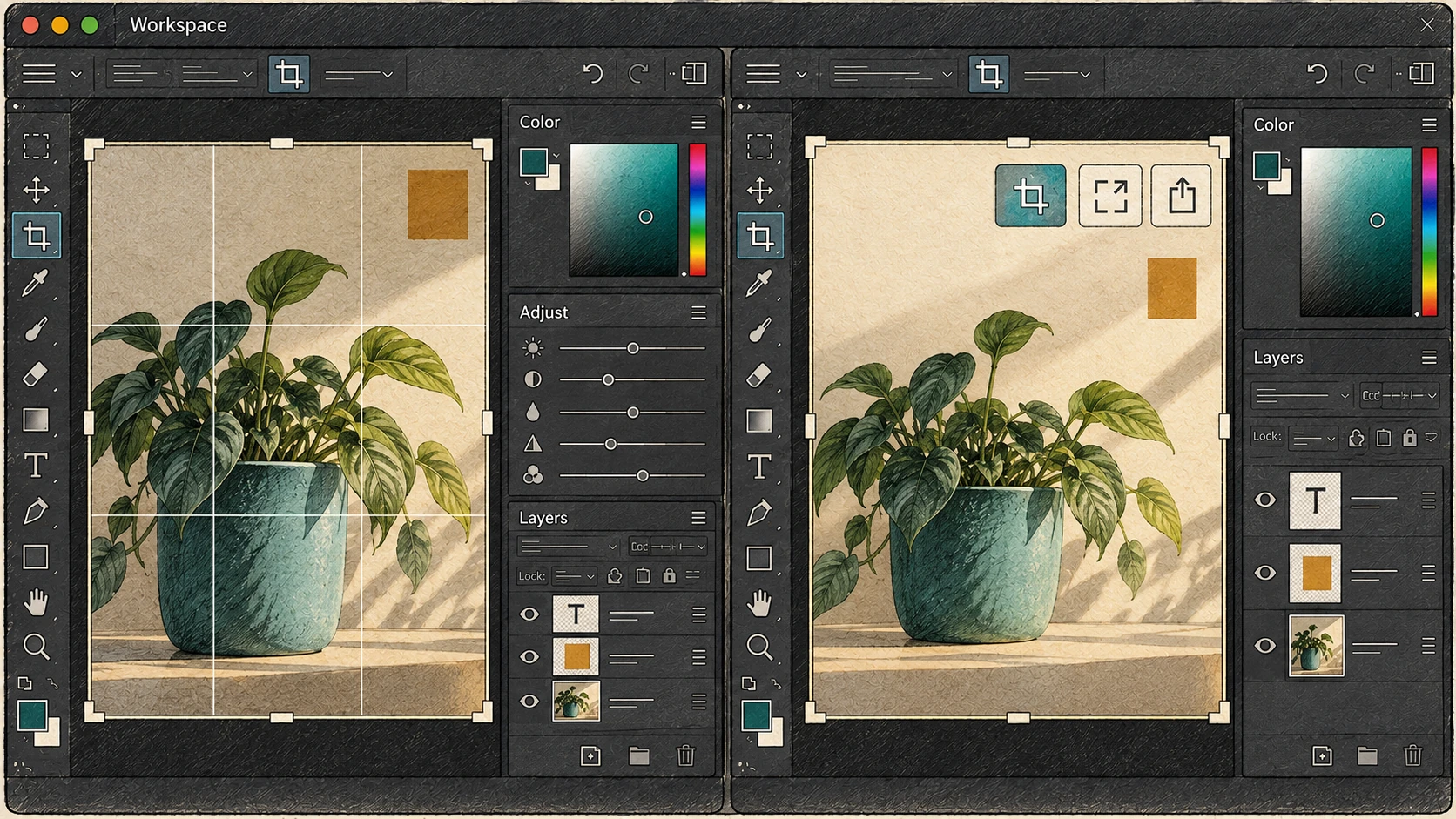
Two editing interfaces working with the same photo. This AI illustration imagines fewer manual steps; it does not demonstrate any product's automation performance.
If those barriers fall, more people will be able to move to other apps with their familiar controls and files. How will established software companies justify today's subscription fees then? As cheaper alternatives with similar features become usable for real work, simply having those features will make a high price harder to defend.
Reddit's business discussions are divided on this point. Some argue that professionals will keep paying because deadlines and file compatibility matter. Others reply that the amount they are willing to pay could still change. A company surviving and a company preserving its current profitability are two different outcomes.
Nor is there any guarantee that the biggest companies will be hit first. In another discussion, commenters worry that independent developers and small studios relying on individual sales may be more vulnerable. Large companies have cash and established customers to fall back on. A small maker could face clones before recovering the cost of building a new product. These are concerns, not verified loss statistics, but they challenge the assumption that trouble for large firms automatically creates opportunities for small ones.
ArtCraft's business model deserves attention here. It offers its clone apps for free while separately selling subscriptions for AI image and video generation credits. Its pricing page says those subscriptions help sustain free and open software. Free apps and a paid AI service coexist in the same business. A lower app price does not mean every source of software revenue disappears.
Established companies are moving too. Adobe has introduced a public beta of AI Assistant for multistep work in apps including Photoshop and Premiere. Autodesk has previewed next-generation AI features intended to connect work across products and projects. These announcements do not mean every task can already be automated. They do suggest that these companies intend to sell the ability to reduce customers' working time alongside the tools themselves.
If that automation becomes part of a customer's daily operations, a software company could charge a service fee that captures some of the labor costs it saves. The customer, meanwhile, could assign the same work to fewer people. The way a software company survives may become intertwined with a reduction in the work available to the people who used its products.
Sources: Reddit r/business — Professional software, reliability, and willingness to pay · Reddit r/antiai — Risks to large companies and independent makers · ArtCraft official app catalog · ArtCraft official pricing — AI generation credit subscriptions · Adobe announcement — Public beta of AI Assistant in Creative Cloud apps · Autodesk announcement — Next-generation AI across products and projects
Reddit comments are individual views, not a market consensus or loss statistics. ArtCraft's free apps and separate AI subscription, Adobe's public beta, and Autodesk's preview are distinguished. The implications for revenue and labor costs are the author's forecast.
6. The next price to change may be the price of our work
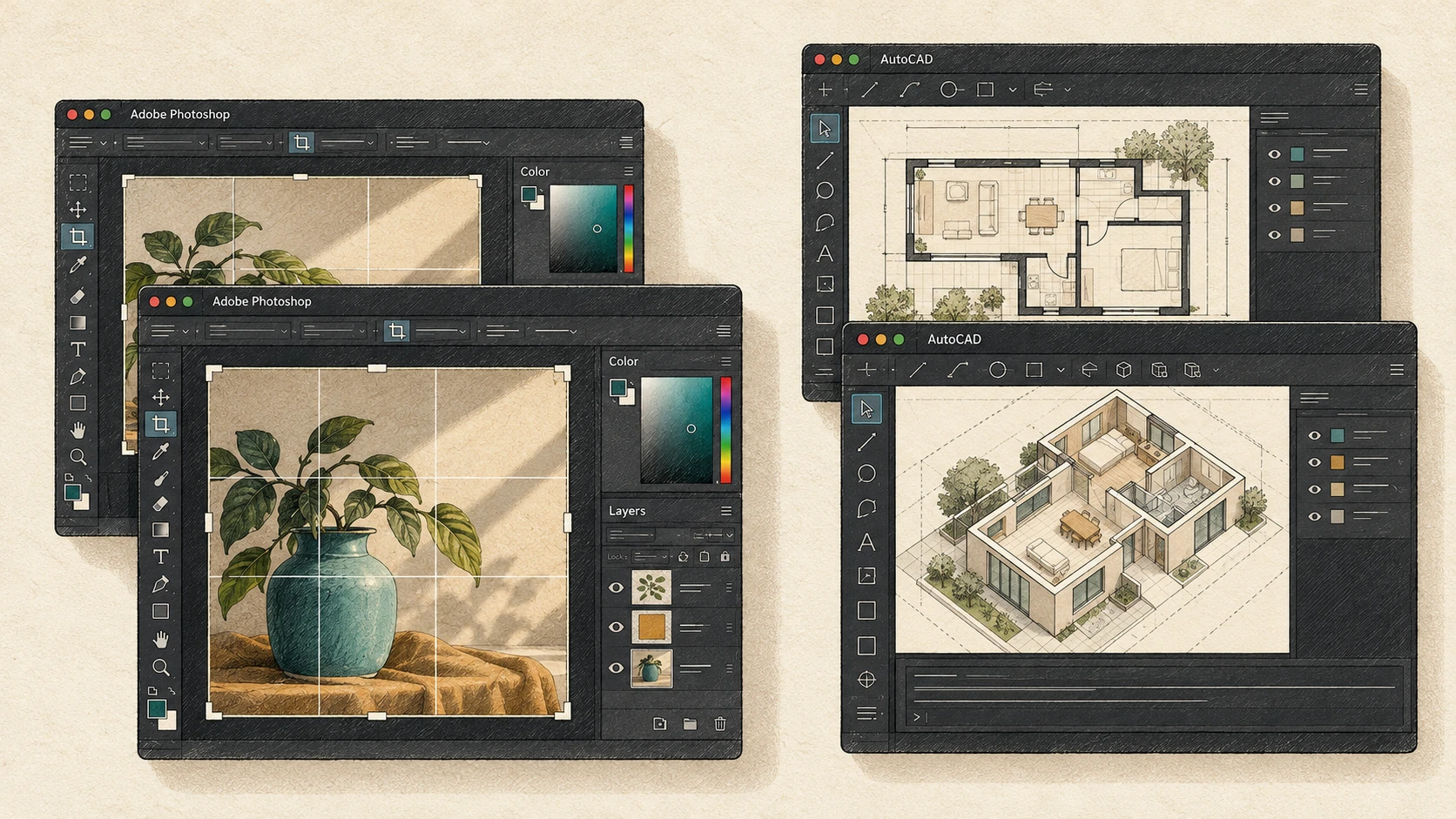
An AI illustration of work made with Photoshop and CAD. As the cost of producing the same result changes, workers' fees and the volume of available work may change too.
Cloning an app and doing a person's work are different steps. A Photoshop-like app does not immediately make designers unnecessary. But if inexpensive tools also automate tasks, clients may be able to finish more image edits or drawing cleanups themselves, to a standard that meets their needs. Some work previously outsourced could disappear as a result.
One Reddit discussion asks who will pay for software if anyone can build it. A reply points out that restaurants still exist even though people can make sandwiches at home. Another counters that demand for restaurants might shrink dramatically if a meal appeared after a single prompt. The useful question here goes beyond whether a service disappears entirely. Can the demand that remains support as many businesses and workers as it does now?
Counting layoffs alone can also miss changes in employment. A Stanford study revised in August 2026 reported that weaker employment among young workers in occupations with greater AI exposure showed up mainly through reduced hiring in U.S. payroll data. It did not find broad displacement across the economy, and the researchers treated the findings as early observations rather than proof that AI caused them. Those figures cannot simply be applied to design and drafting jobs in Korea.
We can imagine job titles remaining while the work within them changes. Revisions that once carried a separate fee become part of the standard service. Tasks that would have justified a new hire are handled by existing staff using AI. The programs and companies may remain, while the number of people sharing the work—and the fees they can charge—changes.
Lower production costs can also create orders and businesses that were previously impractical. Small teams may take on larger projects or accept smaller jobs that were not profitable before. But unless new orders grow as quickly as output per person, producing more will not necessarily mean employing more people.
My expectation is that the near future will bring more software and more finished work produced by fewer people. The ability to make things will spread, while fees for production work alone are likely to face pressure. Some software companies will lose ground; others will earn revenue from automation and AI usage. This is a forecast connecting falling development and production costs with current business models, not a conclusion proved by a handful of clone apps.
A lower Photoshop subscription would certainly be welcome. But if the fees we earn fall by more than the amount we save, we gain as consumers while losing income as producers. That is why the age of cloning is not something we can celebrate without reservation. Alongside the price of software, the next price to be reconsidered may be the price of the work we have been doing with it.
Sources: Reddit r/vibecoding — If anyone can build software, who will buy it? · Stanford Digital Economy Lab — Early labor-market effects of AI
App cloning is distinguished from task automation. The employment study observes a U.S. sample; it does not establish causation or findings about Korean design and drafting jobs. The closing forecast is the author's judgment, not a claim that mass job losses or uniform price declines have been established.
Sources and References
Public sources checked as of October 25, 2026. Product status and availability may change.
Reddit r/foss — Existing open-source projects and AI app clones
A debate between contributing to existing projects and reproducing familiar interfaces. These are conflicting individual views, not performance tests or a representative survey.
GIMP official FAQ — Development goals and interface design
GIMP explains that it is not intended as a Photoshop killer and favors user research and its own design over copying another app's interface.
Thirteen apps from the same team, with their development stages. These are not 13 independent success stories.
PhotoCraft official product page
The maker emphasizes familiar menus, shortcuts, and panels. Actual user relearning time has not been established.
CADCraft official product page
Describes command-based drafting, DXF reading and writing, and DWG opening. Listed format support is not treated as proof of lossless exchange for every file.
CADCraft development notes — AutoCAD parity and remaining work
The maker's account of initial AI implementation and follow-up verification. Older completion estimates and time estimates are not cited as independent measurements of current performance.
Reddit r/ArtCraftAI — PhotoCraft complaints and the early-version debate
Reports about brush and cursor behavior alongside replies emphasizing the early development stage. These are individual experiences, not a verdict on the entire current release.
PhotoCraft issue #6968 — PSD reopening failure after a text edit
Reported October 17, 2026. A failure when a particular edited test file was reopened in Photoshop; read alongside fix #7220.
PhotoCraft pull request #7220 — Fix and Photoshop retest
A change addressing the crash and a retest by the reporter. This does not establish that all related text and file issues were resolved.
Reddit r/business — Professional software, reliability, and willingness to pay
Arguments for professionals continuing to pay, and r2k-in-the-vortex's counterpoint that payment levels can change. Individual views, not measured revenue effects.
Reddit r/antiai — Risks to large companies and independent makers
Includes legendwolfA's concern about small makers' vulnerability. Claims about loss totals, legal judgments, and REA being responsible for ArtCraft's development are not adopted.
ArtCraft official pricing — AI generation credit subscriptions
AI generation credit subscriptions are offered separately from free apps and described as supporting free and open software. No specific prices or discounts are cited, and a subscription is not presented as mandatory for the free apps.
Adobe announcement — Public beta of AI Assistant in Creative Cloud apps
Announced June 18, 2026. A public beta for multistep assistance in apps including Photoshop and Premiere, not evidence of complete automation of every task.
Autodesk announcement — Next-generation AI across products and projects
Announced September 15, 2026. Next-generation capabilities are previewed for later availability. Existing Assistant availability is distinguished from the next-generation preview.
Reddit r/vibecoding — If anyone can build software, who will buy it?
Paraphrases Wide_Egg_5814's sandwich-and-restaurant analogy and Wobbly_Princess's instant-generation counterargument. The question of how many workers demand can support is the author's interpretation.
Stanford Digital Economy Lab — Early labor-market effects of AI
Revised August 12, 2026, using U.S. ADP payroll data through June 2026. Reports weaker employment and reduced hiring among workers aged 22–25 in more exposed occupations, without finding broad employment displacement. Descriptive observations, not causal estimates.