Even a Clumsy AI Performance Gets a Pass When Jang Hang-jun is Involved": What 10 Million Viewers Prove About the Real Competitive Edge of AI Services
I let the awkward tiger acting slide because it's directed by Jang Hang-jun.
An era where persuasiveness, not perfect technology, makes money

〈The Man Who Lives with the King〉 has accumulated12.00 million viewers,according to reports.
But the interesting thing about this movie isn't just the large numbers.
This is especially true considering the current atmosphere in theaters.
For years, these words have been repeated: "People don't go to movie theaters anymore.", "OTT has changed viewing habits."
"The theater has become a place to go on special days." It's a story that sounds almost like a seasonal greeting.
But in that market, one movie is making people sit in theater chairs again, hold popcorn, and search the show schedule.

This scene is quite symbolic.
It doesn't mean the theater is completely finished,
but rather that peoplemay not have found a reason to pay,which is why.
Moreover, this movie is said to havea relatively stable break-even point design.is being said.
From a business perspective, this part is also important.
Rather than shouting "Absolutely super-sized!" from the beginning,it's an approach that controls risk and enhances appeal.It's like approaching it with a method of.
In other words,all-inbut rathera calculated gamble.is closer to.
In the end, the success of this movie is not just a simple box office news story. It sends this message to the theater market.
People haven't left yet.
They justneeded a 'reason to go'.is all.
2. The audience didn't not see the tiger CG. They acknowledged the ticket price even after seeing it.
There is another frequently mentioned issue in this movie, which continues to receive praise.
That isthe tiger CG.is.

The reactions were quite honest. It's very awkward. That scene is disappointing. Immersion is slightly broken.
Eventually, <The Man Who Lives with the King> decided to revise the tiger CG belatedly.
In a nutshell,
it can be evaluated that the problem was not the tiger, but the tiger's acting ability.is about the evaluation.
But the interesting thing starts from here.
Usually, when a technical flaw becomes a meme, the reputation of the entire work also shakes.
This is even more true these days.
With just one short clip or one captured image, the results of months of effort can be
“That scene was funny.”
can be reduced to this one sentence.
But 〈The Man Who Lives with the King〉 strangely went beyond that stage.
People definitely saw it.
They knew the awkward parts and made jokes.
However, most of the final evaluations gathered like this: 'It's still fun', 'It's worth seeing in theaters', 'There are disappointing parts, but the movie is good'.
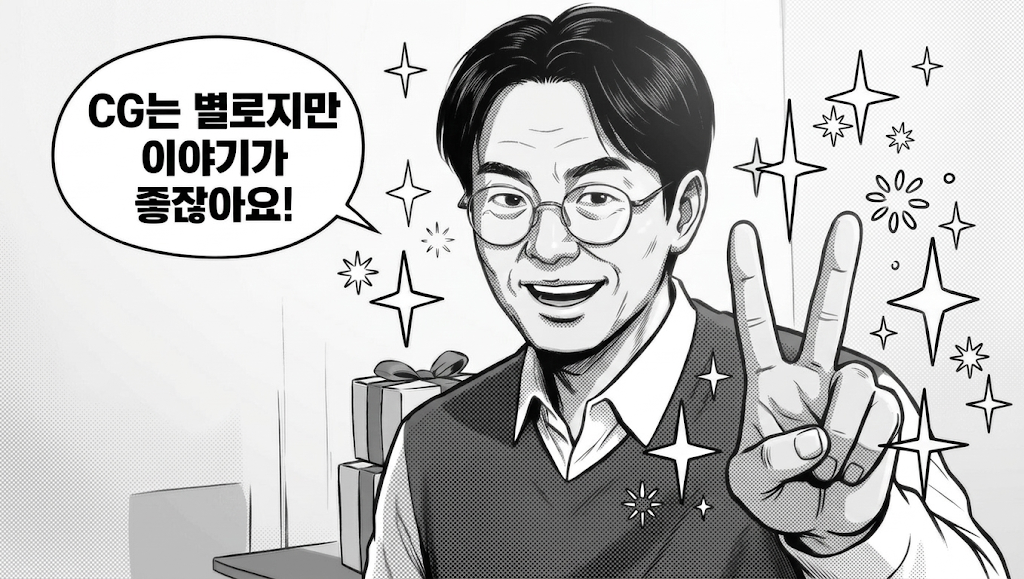
This is a pretty important signal.
It's not that the audience didn't know about the flaws and overlooked them,didn't know and overlooked it,,but rather knew and overlooked them.is because.
Because the final judgment was made based onthe persuasiveness of the entire movie, not the CG.was made with.
This movie didn't hold people because it was technically perfect.
Instead, the narrative drew emotions, the actors built relationships, and the power of the story took the audience to the end.
So even if the tiger slipped up a bit in the middle, the audience thought this:
"Yeah, it was a little awkward.
But I'll keep watching the movie."
In the end, peoplecan admire perfect technology,,
but when they actually spend money, they move based on much simpler criteria: 'Does it take me to the end?' 'Does it convince my emotions?'
And this story is not just about movies.
Right now,the AI market is almost in the same place.
3. Now, in AI, 'Does it do well?' is less important than 'Does it finish my work?'
For a while, AI was justamazing technology.was.
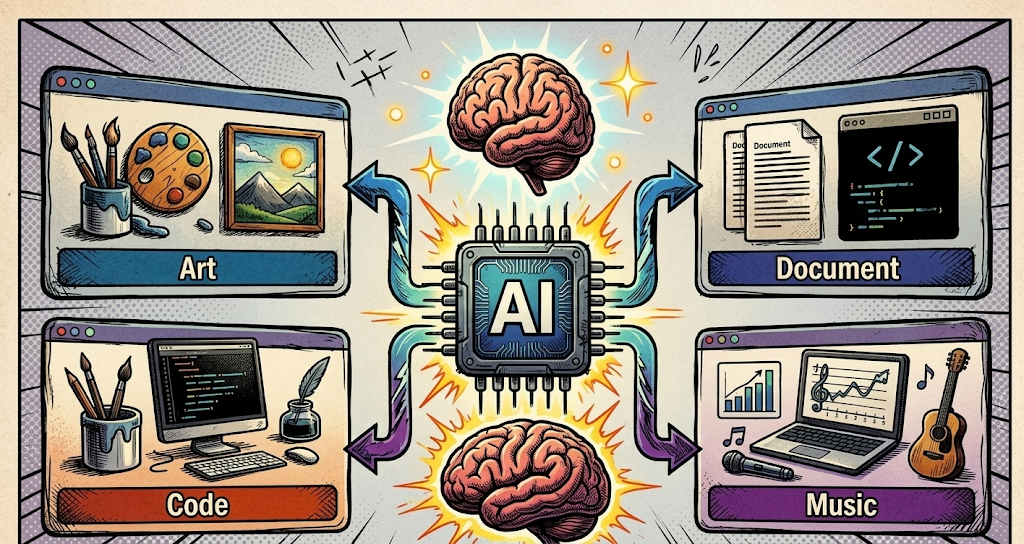
It was amazing if it wrote sentences well,
it was amazing if it created images,
and even just summarizing it gave the feeling that "the world is changing so fast."
But now the situation has changed a bit.
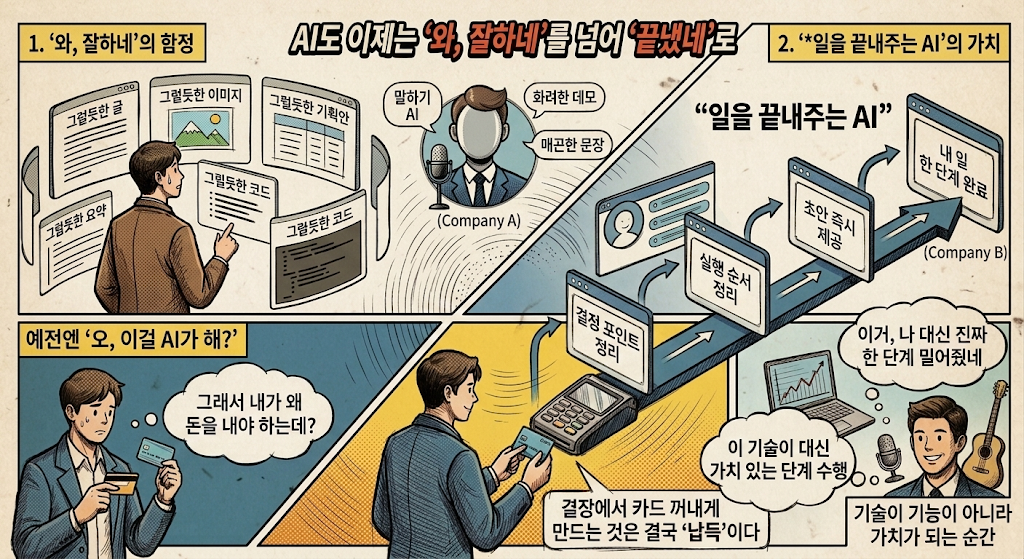
Now,everyone uses AI.Plausible writing, plausible images, plausible proposals, plausible code, plausible summaries.
Most of the results are already coming out to some extent.
The problem isthat plausibility has become too common.is.
In the past,
"AI does this?"
This was a competitive advantage. But that's not the case now.
"Oh, it does well."
If it ends here, it ends there.
Admiration remains, butpayment does not remain.
Because the user's question has changed.
People now ask this:
So how does this change my work?
So why should I pay?
In front of this question,a technology demo is not enough.
Whether the answer is more fancy
Whether the work is actually finishedbecomes much more important.
For example, you can think of this situation.
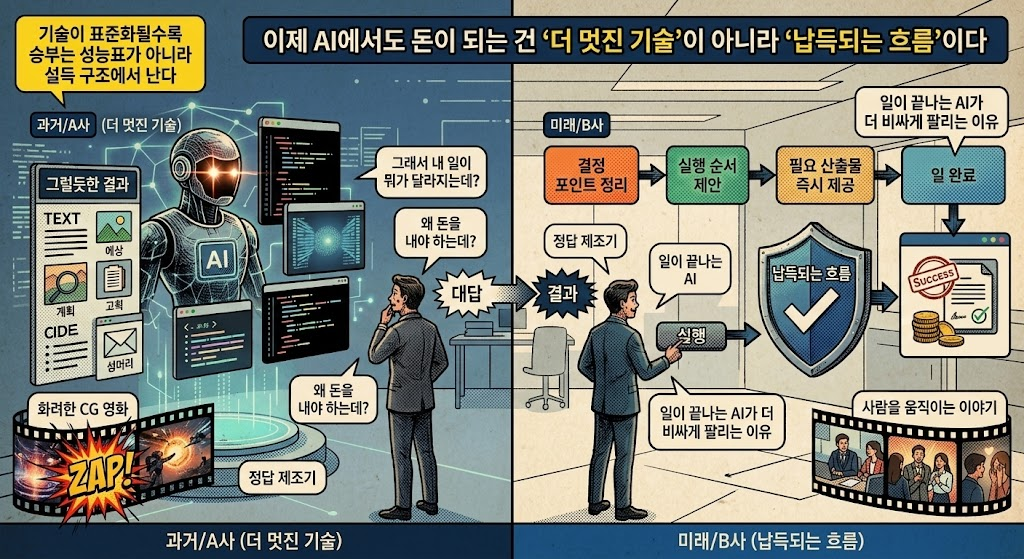
Company A has a more fancy answer.
The sentences are good, the function explanations are great, and the demos are impressive.
On the other hand, Company B may be a little less flashy.
But it allows users totake the next action immediately.It organizes the decision points, divides the options,
and even provides an execution draft.
Then most of the money goes to Company B.
Because the user isnot buying a good answer, but
buying the experience of solving a problem one step further.is.
4. The essence of prompting is not the sentence, but the intention.
The phrase 'good at prompting' is oftenthought of as 'the skill of writing good questions'.think of it as.
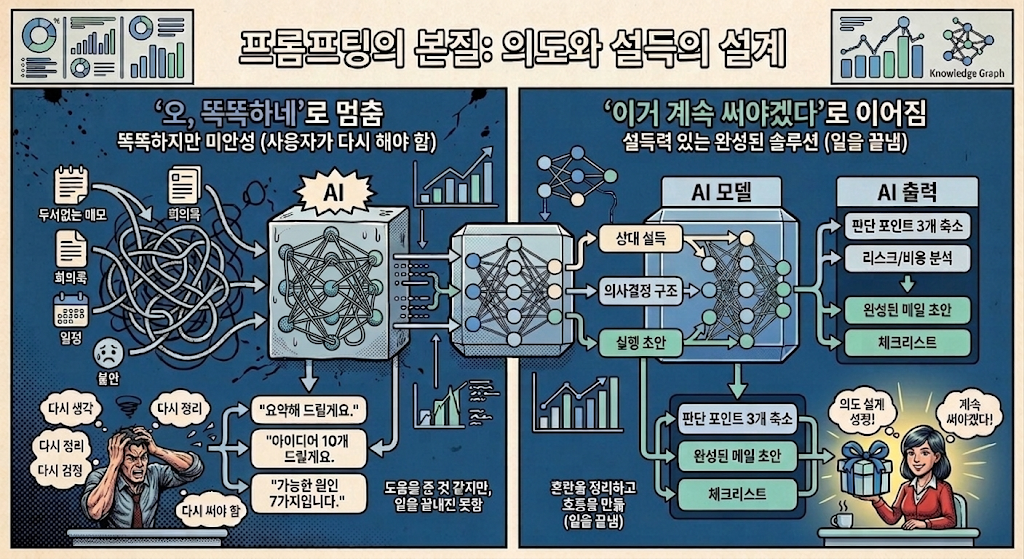
But in reality, it's a problem much earlier than that. More important than what sentence you write iswhether what you want is clear.is more important.
Users don't always ask organized questions. Most of them paste in disorganized notes, yesterday's meeting minutes, today's schedule, and anxieties about tomorrow all at once, and then say, "It's kind of like this..."
The job of AI at that time is not to create a great answer. What you really have to do isto create a flow.is.
Organizing scattered information, showing the points to be judged now, setting the execution order, and marking where the dangerous points are. In the end, it's about enabling the user totake the next action.is.
But this flow is not created automatically by the model. In most cases,the intention of the person who makes that flowmust come first.
If it is not clear whether what I want from AI is a simple summary, a sentence to persuade the other person, a structure for decision-making, or a draft that can be executed immediately, the result looks empty somewhere, no matter how plausible it looks.
So simply smart-looking AIs usually stop here.
"I'll summarize it for you.", "I'll give you 10 ideas.", "Here are 7 possible causes."
It sounds plausible when you read it. But after reading it, the user has to think again. You have to organize again, decide again, and write again.
In the end, it seems like it helped, butit didn't finish the job.is.
On the other hand, persuasive AI moves differently. Even if it provides a summary, it reduces the number of points to be decided now, divides the risks and costs for each option, and provides a draft email or checklist that can be sent immediately.
This difference is bigger than you think.
The formerends with “Oh, it’s smart.”ends with.
The latterleads to “I should keep using this.”leads to.
5. In the end, one question remains.
Come to think of it, movies are the same.

〈The Man Who Became King〉 didn't draw crowds because it was technically perfect. On the contrary, there were clearly shortcomings. Yet, the movie carried the audience through to the end.
Because this movie, at least,had a clear direction on what it wanted to show, what emotions it wanted to leave behind, and why the audience should follow this story.The tiger CG might have wavered for a moment, but the movie's driving
The tiger CG might have wavered for a moment, but the movie's drivingaxis of intention and emotiondid not waver. So the audience didn't waver either.
The same goes for AI.
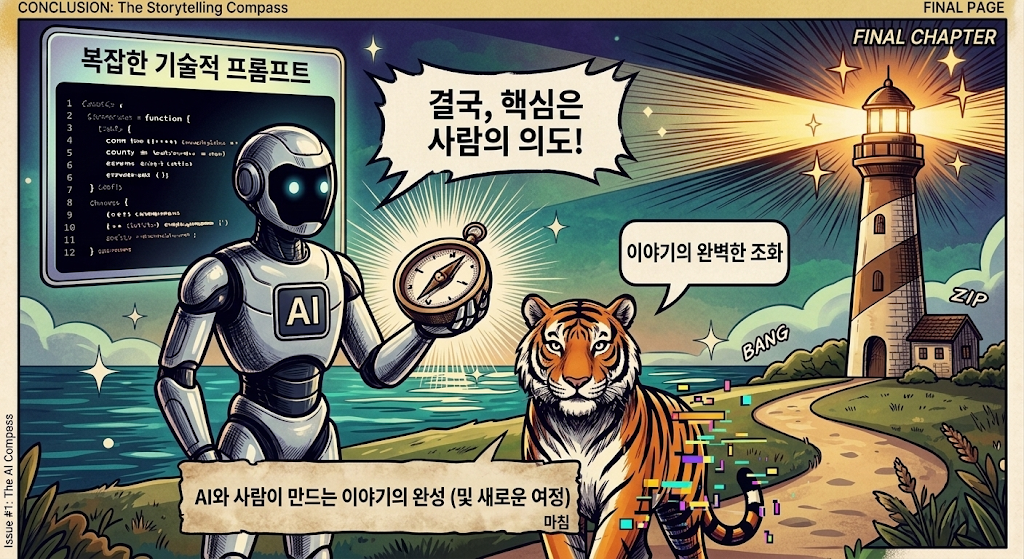
These days, everyone writes prompts. Everyone produces some kind of result. So what has become more important iswhat you intend to ask, rather than how you ask it.It is.
Is it to organize information, to persuade the other party, to help with decision-making, or to generate actual actions? If this direction is not clear, the prompt has no power, no matter how long it is.
Conversely, if the direction of intent and persuasion is clear, the results are much stronger, even if the technology is a little less flashy.
So, in the end, the question remains one.
Are we creating flashy CG, or are we creating a story that people keep watching?
Using AI well is not a skill of making good conversation.
It's about knowing clearly what I want and how far I want to take the other person.
I think that is ultimately the ability to use AI properly.