In the Age of AI, the Ship of Theseus Remains as Versions, Not a Single Answer
From a philosophy of finding the original to a philosophy of understanding change history
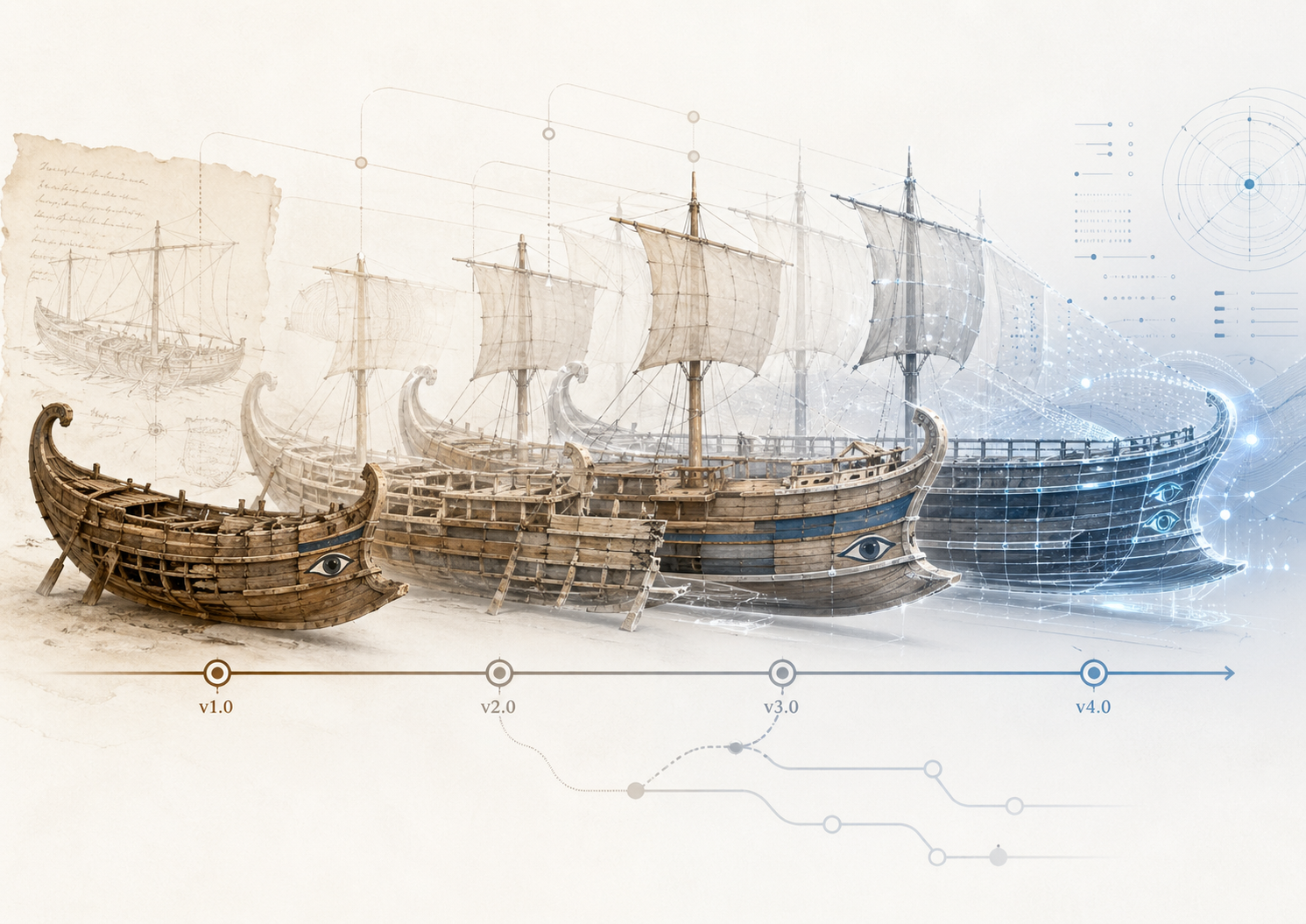
Some questions are not old because they are outdated,
but they continue to be new because they are old.
This is the case with the Ship of Theseus.
This question seems very simple.
If the parts of a ship are replaced one by one until all the parts have been changed,
is that ship still the original ship?
At first, it feels like an old thought experiment that would be found in a philosophy class.
However, I think this question is becoming important again in the age of AI.
Because in the age of AI, almost everything keeps changing.
Let's imagine that the Ship of Theseus has returned to port today.
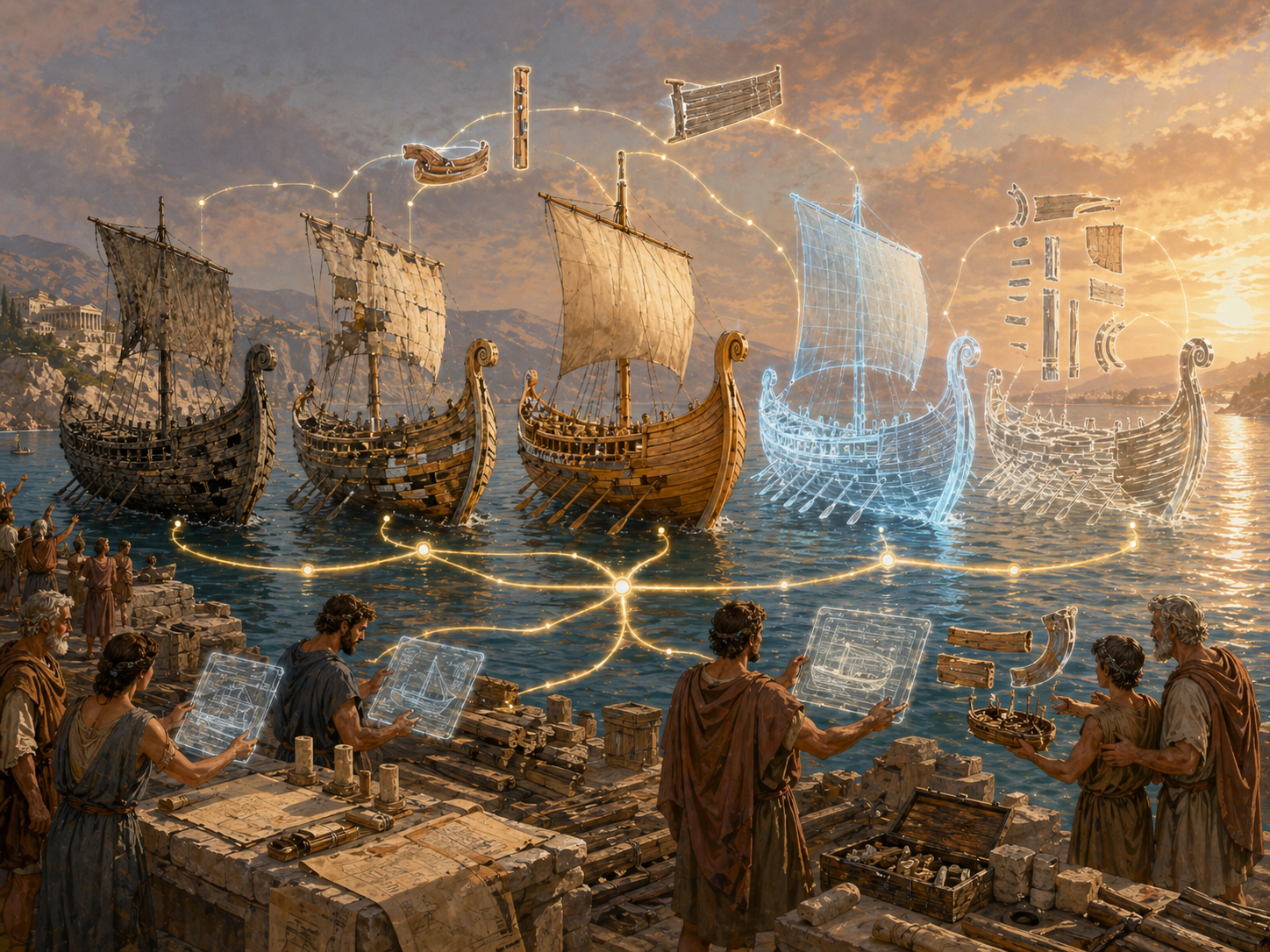
But it's not just one ship that has arrived at the port.
There is a record of the original form preserved before the repair, a history of parts replacement, a navigation log, a history of design changes, a digital twin, and restorable versions at each point in time.
Now we ask:
Which one is the real Ship of Theseus?
But perhaps this question itself needs to change.
The old Ship of Theseuswas a problem of asking, when A is changed to B, which one is real?was a problem of asking, when A is changed to B, which one is real?
The Ship of Theseus in the age of AI is different.
Now, the important thing is not to choose one of A and B.
It is to understand what change history connects A and B, and what versions each remains as.
The original does not disappear but remains as a version.
Change does not remain as a break but as a history.
Identity does not remain as a single answer but as a genealogy.
1) Why hasn't this question ended for 2,000 years?
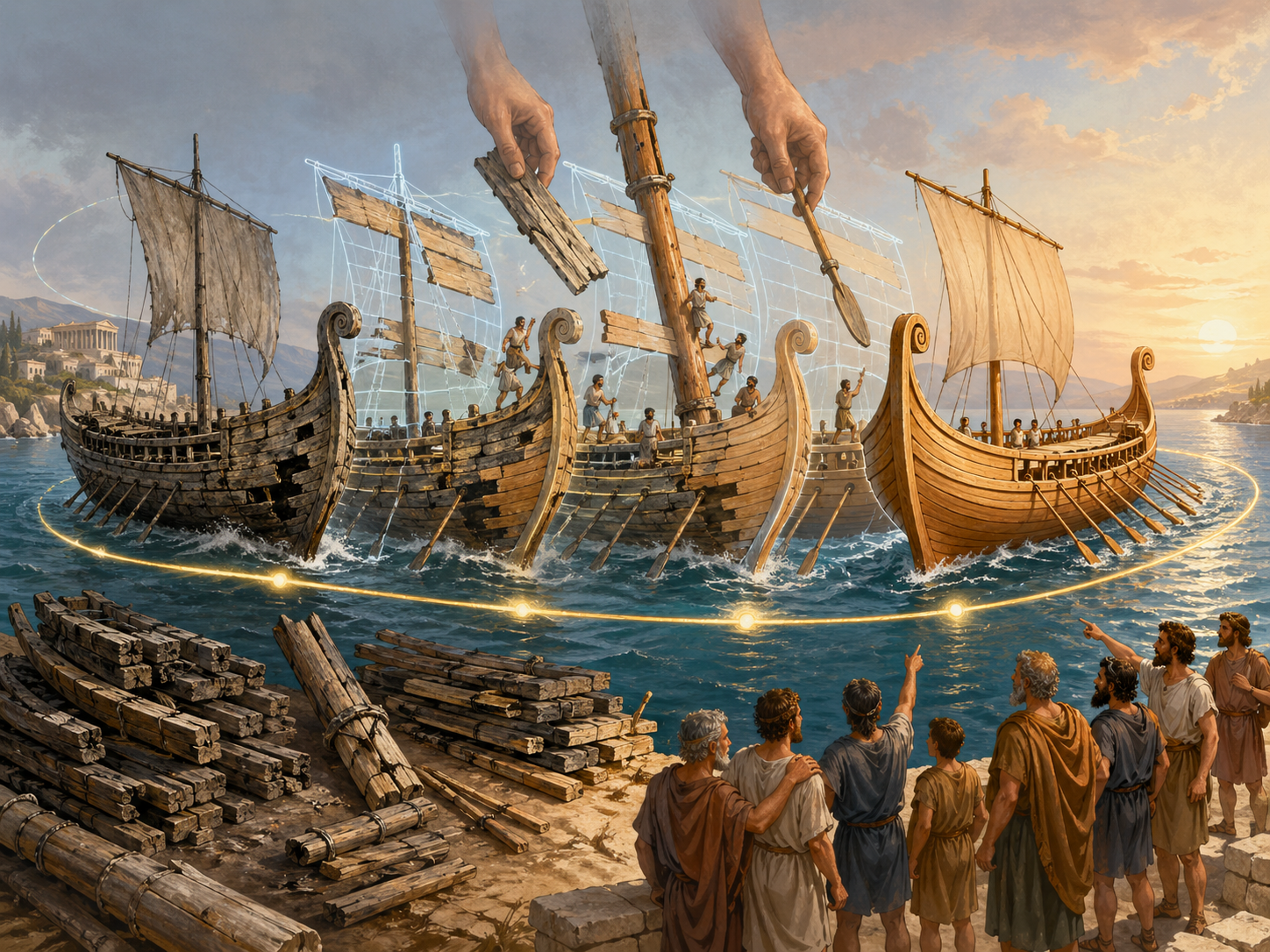
The Ship of Theseus is an old philosophical thought experiment.
If the parts of a ship are replaced one by one until all the parts have been changed, is that ship still the original ship?
This question seems simple, but it doesn't end easily. This is because there is more than one criterion for the word "same." If the original parts are important, then a ship with all the parts replaced may no longer be the original ship. From this point of view, identity is inmatter.If the original wood, the original parts, and the original materials have disappeared, it can be said that the original ship has also disappeared.
But you can also look at it differently.
What if the shape and structure of the ship are maintained even though the parts have been changed? What is important at this time isform.What structure it maintains becomes more important than what it is made of.
There is another criterion. Can it be said to be the same ship if it still sails, performs the same purpose, and plays the same role?
From this point of view, identity is infunction.What if people continue to call the ship by the same name and remember it as the same symbol?
At this time, identity isname and social recognition.gets closer to.
And finally, what if the ship has continued in the same history without interruption? Even though the parts have been changed, what if the process of being repaired, preserved, and operated has continued? In this case, identity is inhistory and continuity.is in.
That's why the Ship of Theseus has not been summarized into a single answer for 2,000 years.
That doesn't mean it's a problem without any conclusions. Rather, this problem shows an important fact.
Identity is not easily determined by just one criterion.
The answer changes when viewed as matter. The answer changes when viewed as form. The answer changes when viewed as function. The answer changes when viewed as name. The answer is different when viewed as history.
The reason why the Ship of Theseus has survived for so long is not because this question is difficult. This is because this question continues to reveal what we actually base our standards on when we say "same."
2) Existing discussions ultimately tried to find one identity
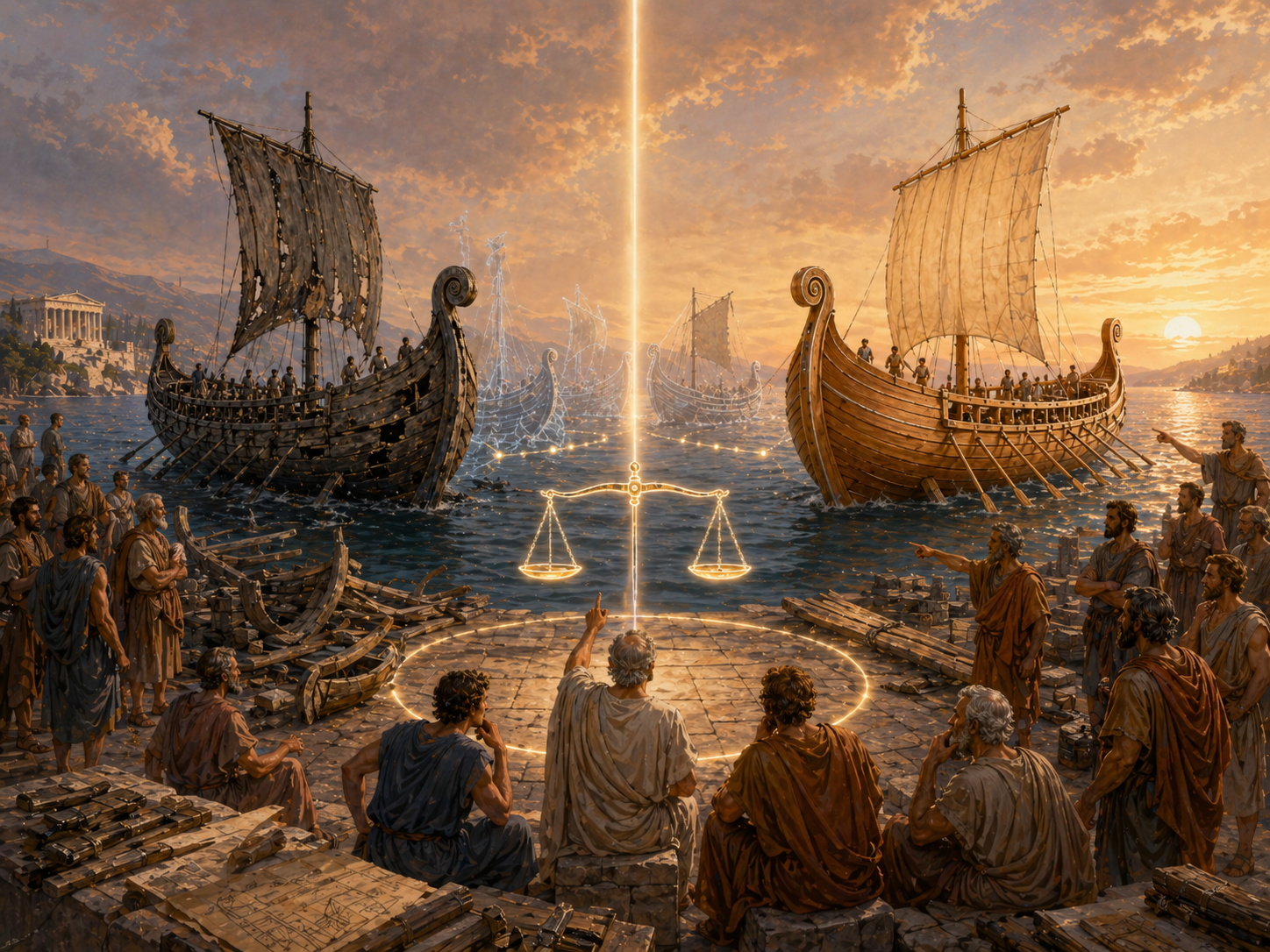
There were many answers to the Ship of Theseus. However, most discussions had a common direction. The point is that they ultimately tried to find one main identity.
Is the ship with the original parts remaining the real one? Is the ship that continued to operate the real one? Is the ship preserved under the same name the real one? Is the ship that maintained the same shape and function the real one? The questions were slightly different, but the structure was similar.
Which one is real?
This question has the pressure of choice. When A and B exist at the same time, one of them must be judged to be closer to the real one.
A is important based on matter. B is important based on form and function. The process from A to B is important based on history. However, in the traditional world, it was difficult to preserve and compare all of these at the same time. Parts disappeared, records were incomplete, and past states were mostly irreversible.
Therefore, identity was largely judged based on what remains today.
Current matter, current form, current function, current name, history that has continued to the present.
In other words, the existing Ship of Theseus was this question.
Has it changed, but is it still the same?
This question does not disappear in the age of AI. However, it becomes insufficient.
Because change does not disappear now.
3) In the age of AI, change does not disappear but remains
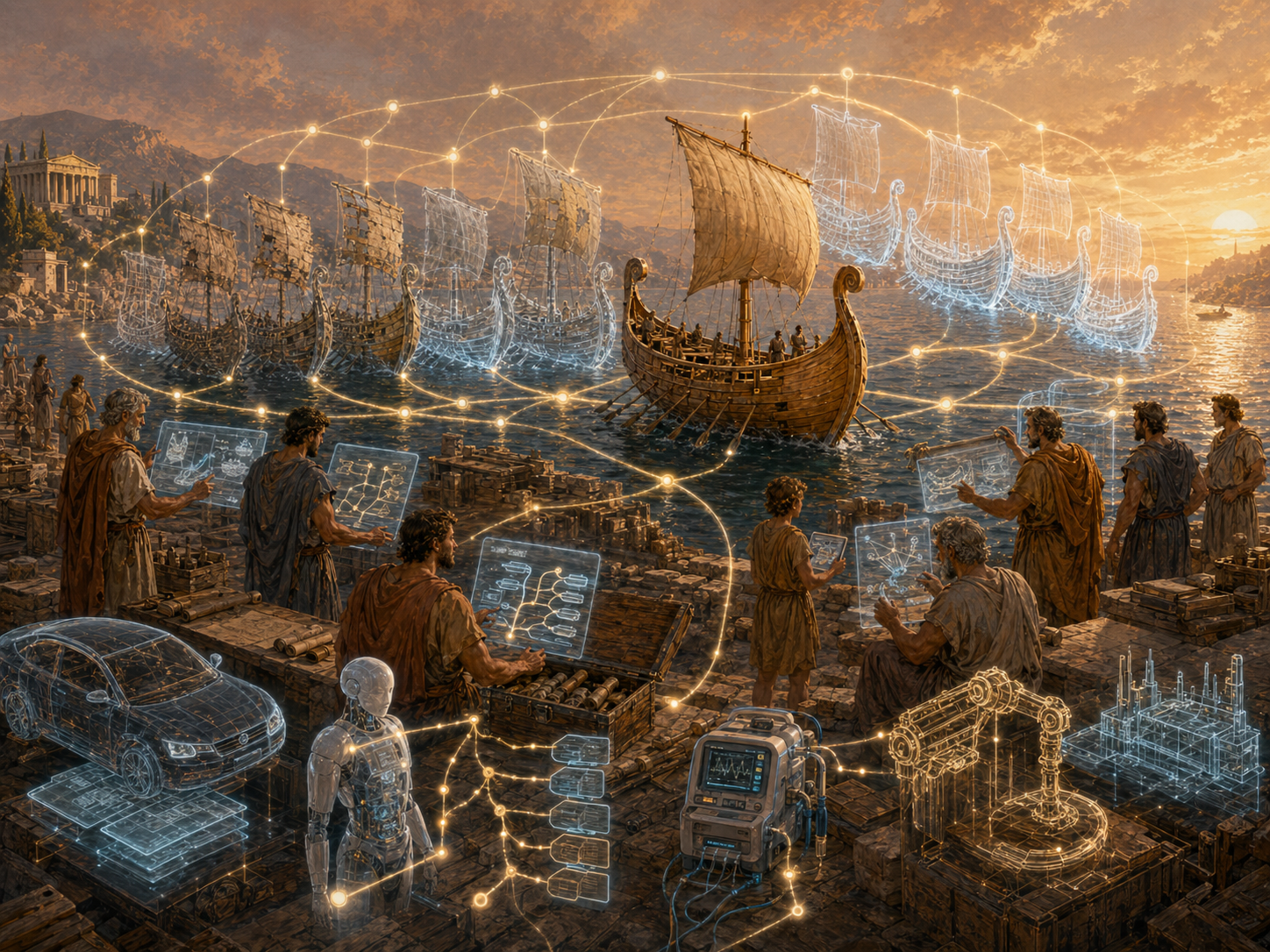
The biggest change in the age of AI lies in the way objects themselves change.
Everything has changed in the past.
People change, organizations change, documents change, and products change.
However, many changes disappeared after they passed.
Memories faded, records were missing, and past states were difficult to restore.
The situation changes in the age of AI.
Software leaves an update history.
Documents leave a revision history.
AI models have learning data, model versions, evaluation results, and policy change histories.
Content is divided into drafts, revisions, and distributions.
Services are continuously adjusted to reflect user feedback and logs.
Physical objects are also increasingly moving in the same direction.
Cars receive software updates.
The control model of robots changes.
Medical devices leave sensor logs and maintenance records.
Factory equipment is connected to digital twins.
Now, things do not simply exist as current objects.
It becomes an object with state and history.
An important transition occurs here.
Change does not disappear, but remains as a history.
This may seem like a technical explanation, but it is actually a philosophical shift.
Identity is no longer explained by just one current state.
What changes the object has undergone becomes important.
What version is it?
What data was reflected?
What policies were applied?
Who modified it?
When was it deployed?
How far can it be rolled back?
These questions are increasingly becoming part of identity.
4) So the Ship of Theseus remains as a version, not a single answer
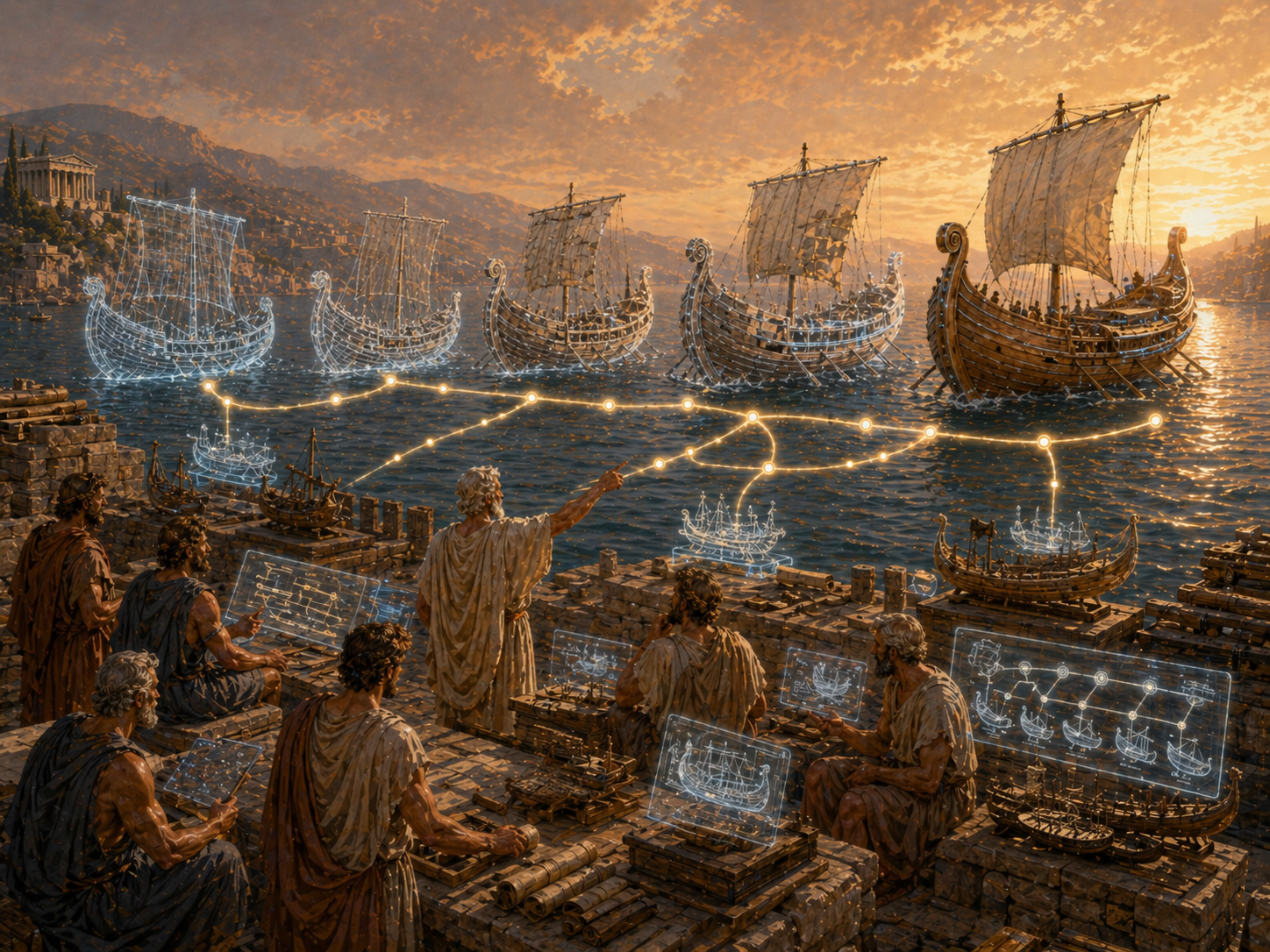
Now let's look at the Ship of Theseus again. The existing question was this.
Which one is real, A or B?
The question in the age of AI is different.
What version relationship do A and B have?
For example, you can see it like this.
Ship v1.0: 최초의 배
 Ship v1.1: 일부 부품 교체
 Ship v1.2: 구조 보강
 Ship v2.0: 핵심 구조 변경
 Ship v3.0: 새로운 항법 시스템 적용
In this structure, v1.0 does not completely disappear just because v3.0 has been released. v1.0 remains as the initial version. v1.1 remains as a version with some parts replaced. v2.0 remains as a version with a significantly changed structure. v3.0 remains as a version with a new system applied. The important thing is not to choose only one as real. It is to understand what relationship each version is in.
This perspective becomes clearer when you think of Git.
In Git, the identity of a project is not only in one current set of files. The initial commit, modification commit, branch, merge, rollback, tag, and release all make up the history of the project. If you only copy the current file, it may look like the same project on the outside. However, it is a completely different matter what change history the project has gone through to reach its current state.
The same is true for the Ship of Theseus.
The Ship of Theseus in the age of AI is not understood as just one ship currently floating. It is placed in a change history and version genealogy. Identity becomes a flow, not a single point. And that flow can be compared, restored, and branched when needed. So I would like to summarize it like this.
The Ship of Theseus in the age of AI does not remain as a single answer, but as a version.
5) AI models and content are already becoming versions
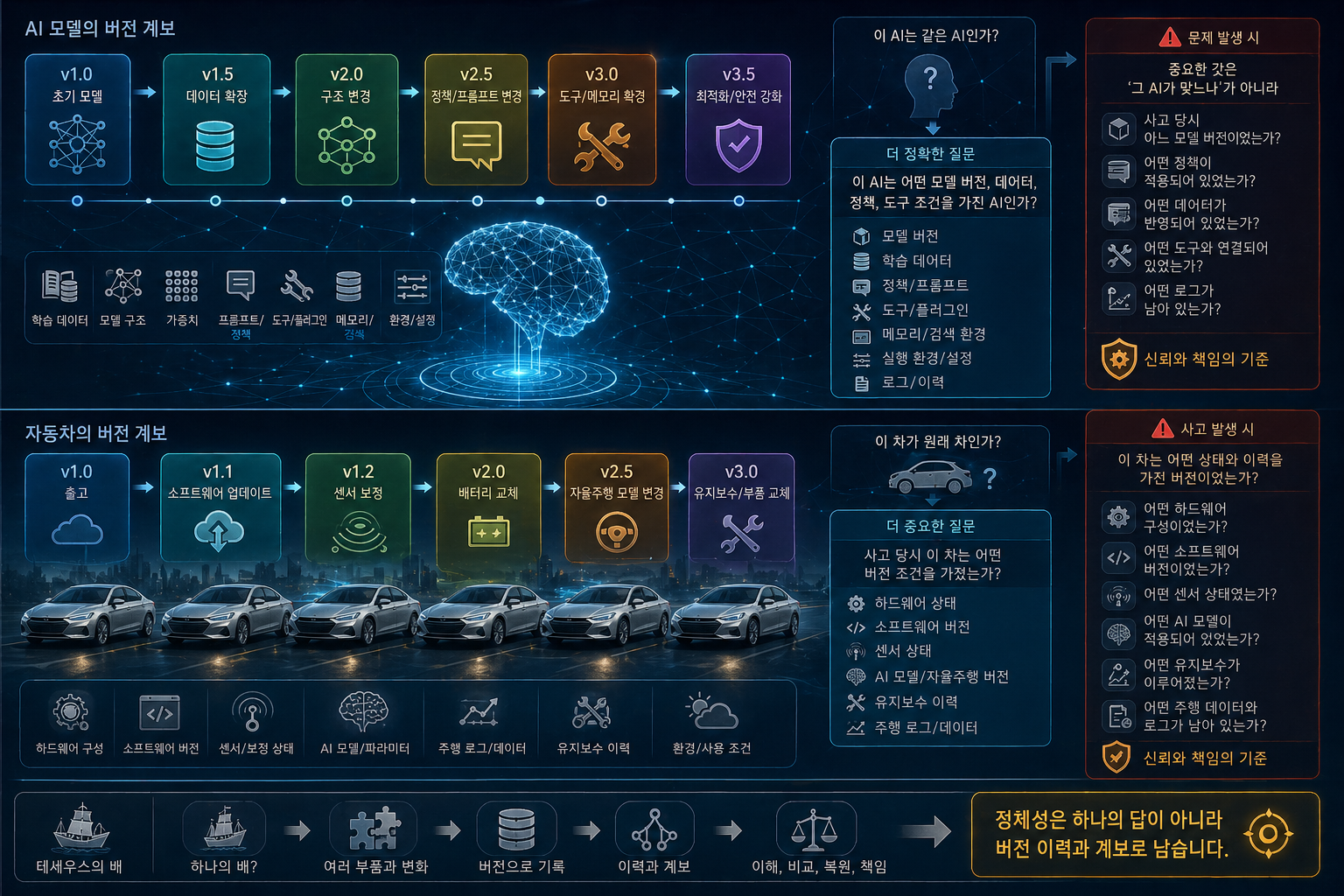
This perspective does not only stay in abstract philosophy. Actual objects in the age of AI are already becoming versions.
Let's look at the AI model first.
An AI model is a more complex Ship of Theseus than simple software. It's not just the code that changes. The learning data changes.
The model structure changes. The weights change. The system prompt changes. The policy changes. Tool connections change. Memory and search environments can also change.
Then the question is not simple.
Is this AI the same AI?
This question alone is not enough. A more accurate question is this.
What model version, data, policy, and tool conditions does this AI have?
The same is true when a problem occurs in an AI system.
The important thing is not "Is that AI correct?" What model version was it at the time of the accident? What policies were applied? What data was reflected? What tools were connected? What logs remain? These questions become the criteria for trust and responsibility.
Physical objects are no exception.
A car is no longer explained only by the car body and engine at the time of shipment. Software updates, sensor calibration, battery replacement, autonomous driving model, driving log, and maintenance history together make up the state of the car.
If an accident occurs, the important question may not be this.
Is this car the original car?
A more important question is this.
At the time of the accident, what hardware, software, sensor status, AI model, and maintenance history version was this car in?
Now, physical objects are also beginning to be understood not as one current object, but as an existence with a state history and version conditions.
6) From the philosophy of the original to the philosophy of version history
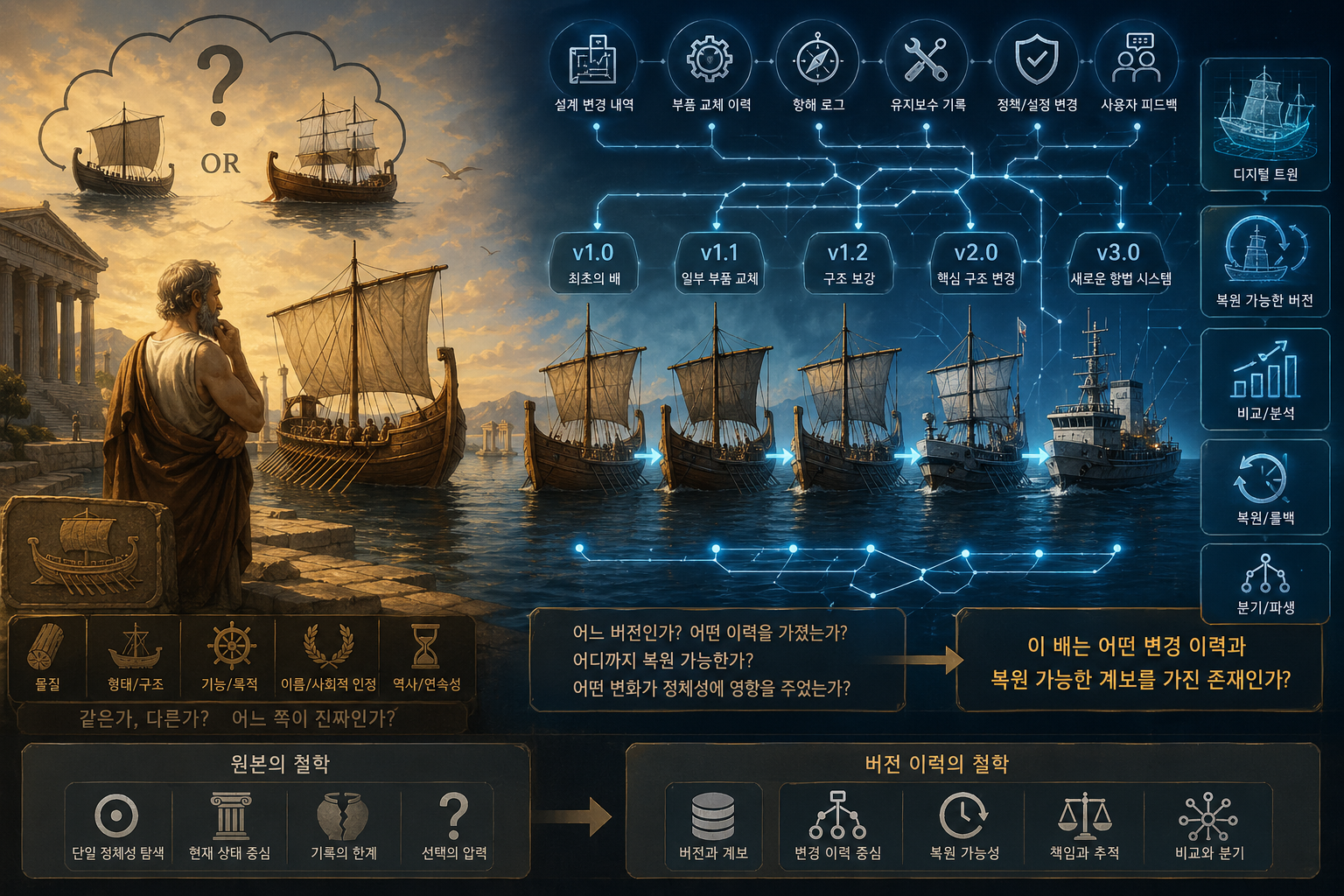
The version perspective does not completely eliminate the Ship of Theseus problem.
Rather, it changes the question. The existing question was this.
Same or different? Which one is real? What is the original?
The question in the age of AI is slightly different.
What version is it? What history does it have? How far can it be restored? What changes have affected identity?
This change is not small.
For 2,000 years, the Ship of Theseus was a question of whether one identity is maintained even in the midst of change. However, in the age of AI, identity is not selected as just one answer. Identity remains as a version history and genealogy. The original does not completely disappear.
The original remains as v1.0.
Change is not a break. Change remains as an update history. The current state is not everything.
The current state is one version.
So the key question in the age of AI is not this.
Which ship is real?
Now, the more important question is this.
What change history and restorable genealogy does this ship have?
AI is not just a technology that makes us create more. AI is a technology that makes us re-ask how what we create changes, how it is recorded, and how we should be responsible for it.
In the end, the Ship of Theseus in the age of AI is not the philosophy of the original.
The Ship of Theseus in the age of AI is the philosophy of version history.