The Age of AI Agents: Harnessing the Competitive Edge
An Uncomfortable Question Thrown by an April Fool's Day-like News
When I first saw this news, I honestly thought it was an April Fool's joke.
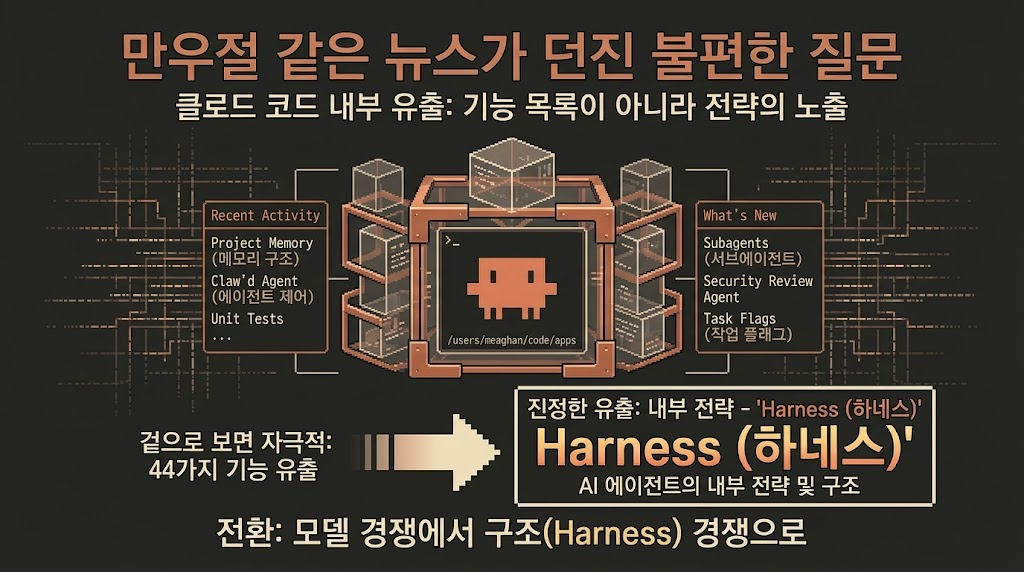
The story that the internal code of Claude's code had been leaked externally. Moreover, it was a report that not only some simple code, but also traces of the internal implementation structure and unreleased features were revealed.
On the surface, it's a sensational incident.
People's attention naturally focused on keywords such as "44 features that have not yet been implemented." Background agent, memory structure, remote control, feature flags for long-term tasks. It's interesting enough, and a strong topic for news.
However, if you look a little closer, the essence of this incident is not there.
The entire code was not stolen, the model weights were not leaked, and it was not confirmed as a customer data breach. Therefore, it is unlikely that this incident will directly lead to a blow that shakes the company's existence.
But that doesn't mean we can take it lightly.
Because what was revealed this time was not just a list of features, butthe internal strategy of how to make an AI agent into a product.And it is at that point that we read an important transition.
And it is at that point that we read an important transition.
Now, the competition doesn't stop at "who has the better model."
What is becoming increasingly important iswhat structure to put that model in and how to make it move.That is.
The name of that structure isharness.That is.
What is a harness, and what is harness engineering?
In simple terms, a harness is
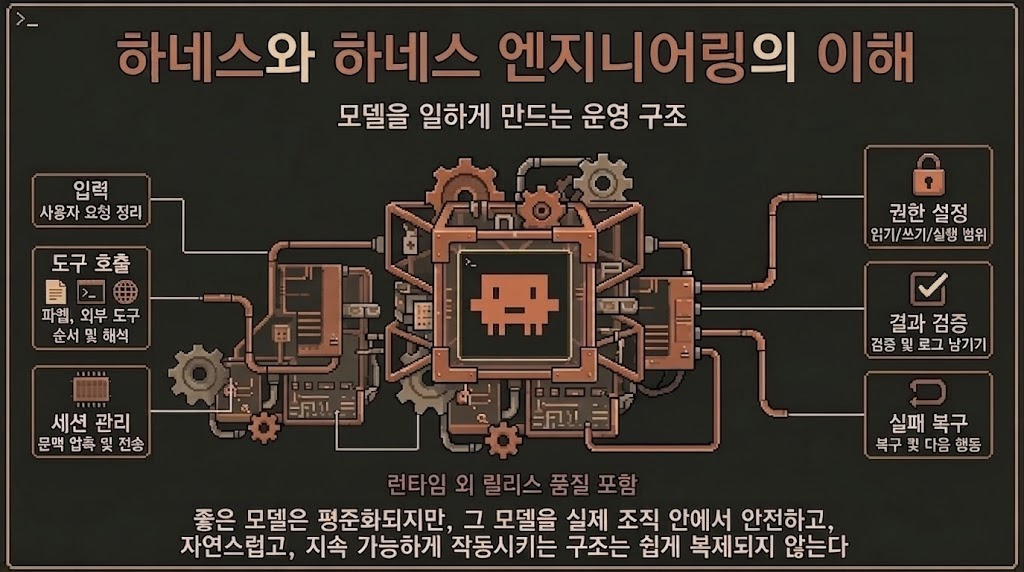
an operating structure that makes the model actually work.That is.
If the model is an engine, the harness is
a system that determines what input the engine receives, what tools it uses, what authority it has,
when it stops, and how it is verified.
In other words, the harness is not just an additional function, but
an execution structure that makes the model work as an agent.It is closer to.
This usually includes the following elements.
How to deliver a request
What tools to connect
How far to read, write, and execute
How to maintain context in long tasks
How to verify and record the results
And designing this structure is
harness engineering.That is.
This is not just about writing prompts well,
but about ensuring that AI actuallyoperates safely and consistently within the actual work.That is a design task.
In the end, harness engineering is
not about making AI smarter, but
about making AI more reliable and usable.It can be seen as.
Now, what matters is not the model, but how the model moves.
For a while, the competition in the AI industry was relatively clear.
Who trains a larger model.
Who produces higher inference performance at a lower cost.
Who processes longer contexts and gives more accurate answers.
Of course, this competition is still valid.
Good models are still important.
However, as we enter the agent era, the nature of its importance has changed slightly.
Now the model doesn't work alone.
It reads files, executes shells, opens browsers, summarizes contexts, passes states to the next session, and, in some cases, breaks down subtasks and re-verifies them on its own.
In this process, it is not just the intelligence of the model that determines performance.
What tools were connected
What permissions were granted
In what situations was it stopped
What results are logged and verified
How to recover and retry when it fails
How to organize and continue the context as the session gets longer
All of this creates the actual quality of the agent.
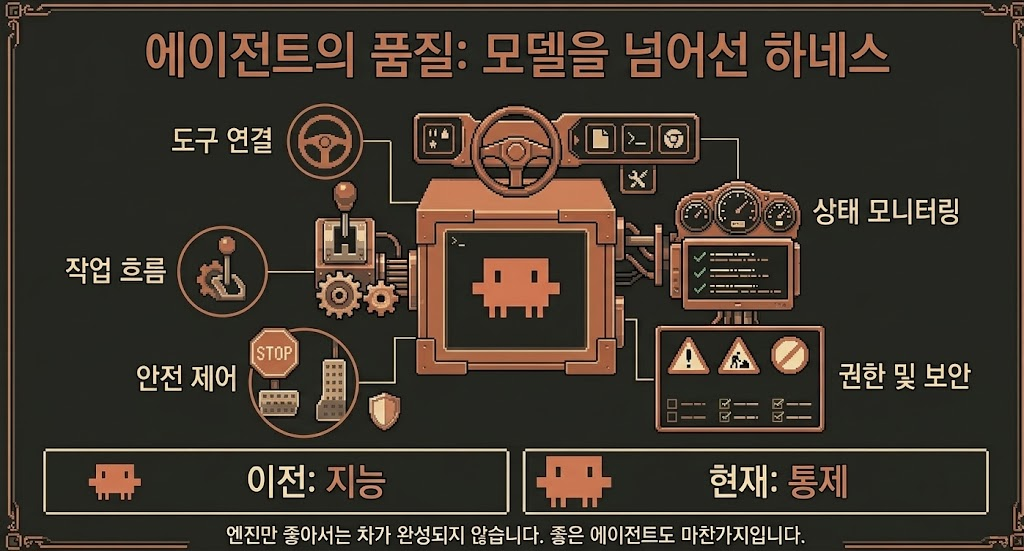
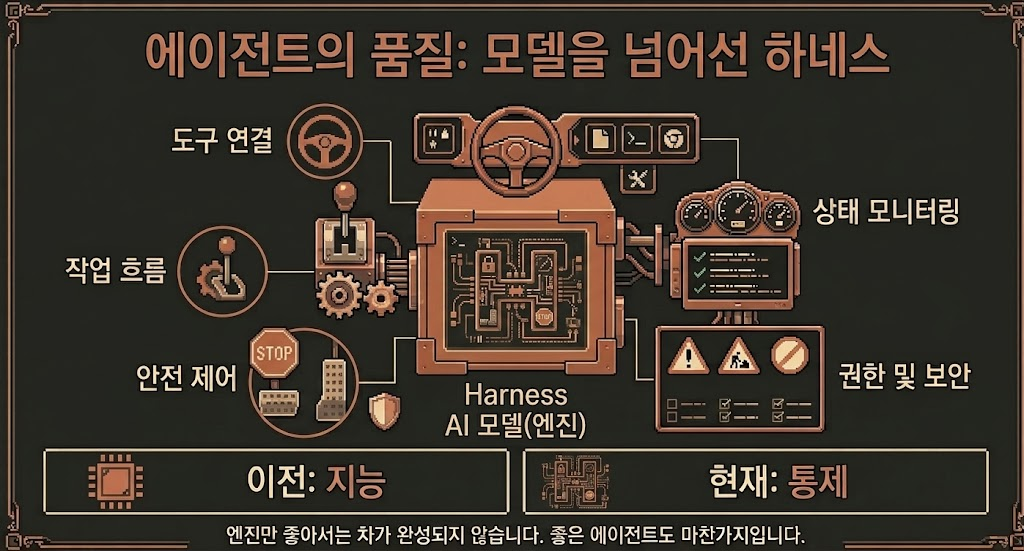
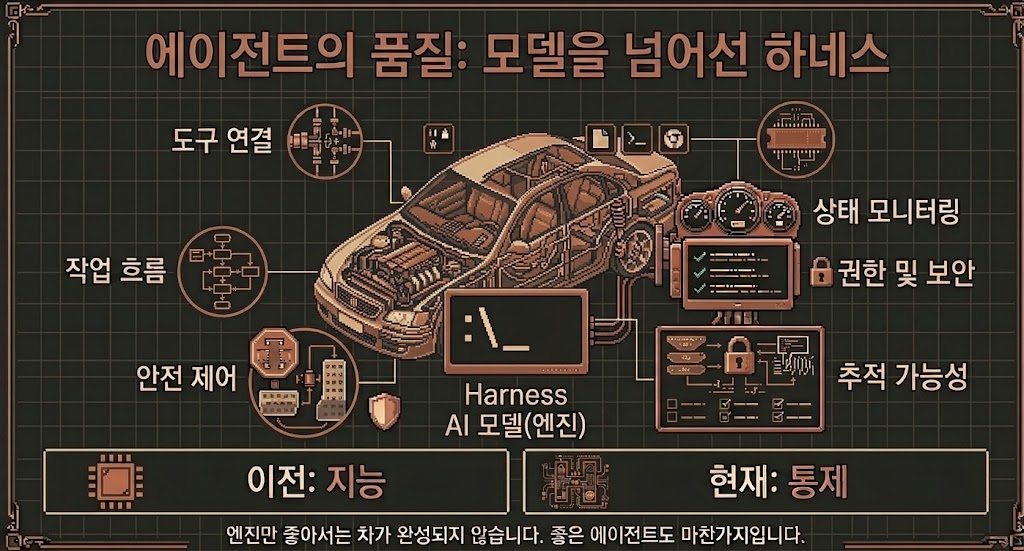
In other words, if the model is an engine,
the harness is a transmission, a steering device, a brake, a dashboard, and driving rules.That is.
A car is not complete with just a good engine.
The same goes for good agents.
Why has the harness suddenly become an important word?
The word harness was not originally a very flashy expression in the AI industry.
However, the reason why this word has appeared frequently recently is clear.
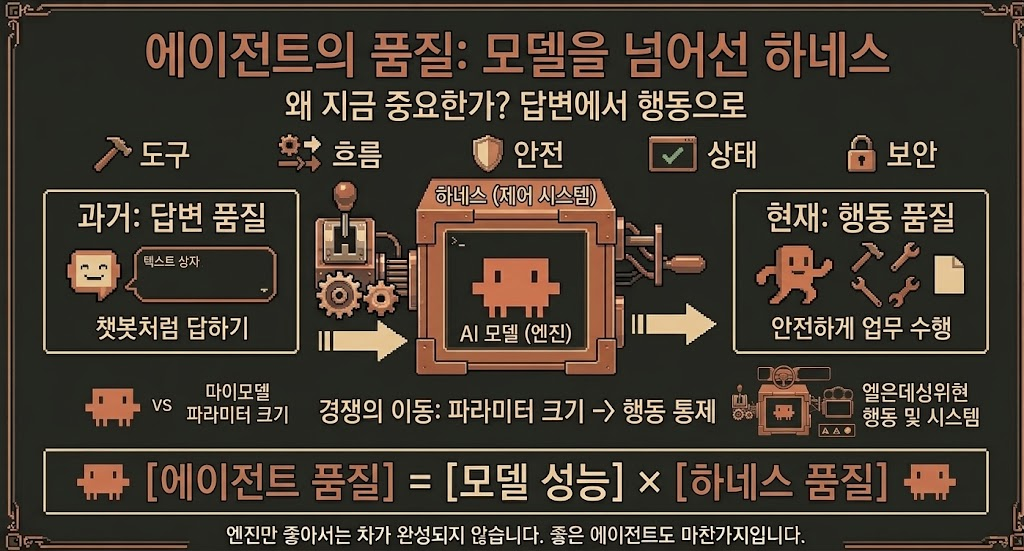
As AI agents enter actual work, the focus of the problem has shifted from "answer quality" to "behavior quality."
Answering questions well and
reliably performing actual work are completely different dimensions of the problem.
For example.
When an agent is assigned to code modification work,
what matters is not just the ability to generate code well.
Does it not incorrectly expand the scope of modification?
Does it not touch sensitive files?
Does it run a test first?
Does it not forcibly overwrite when it fails?
Does it not forget the initial context during a long session?
Does it organize it in a reviewable form before moving on to the next task?
These problems cannot be solved by the size of the model parameters.
This is aharness design problem.That is.
So now the competitiveness is changing more and more like this.
Having a smarter model
→ Creating an agent that works more stably
→ Designing a harness that supports that agent well
In the end, the quality of the agent era is
Model performance × Harness qualityIt is determined by the product of.
The reason why this leak is painful is that the 'operating philosophy' was revealed rather than the 'secret function'.
People usually focus on "what leaked" when looking at leaks.
But what is actually more important iswhat was revealed.That is.
The really painful part of this incident is not the fact that unreleased features were revealed.
The point is that the direction these features point to was visible to the outside.
Memory between sessions.
A structure that allows you to withstand long-term work.
Authority bypass and approval flow.
Background agent.
Tool orchestration.
Operating structure connecting local and remote.
These traces are not just implementation details.
That companywhat kind of existence was AI agent seen as?,
And that beinghow to make it a controllable product.Shows.
In other words, what was leaked was code, but
what was actually exposed wasproductization strategy.That is.
The model may have been hidden.
But the way to turn the model into a product,
in other words,harness philosophywas revealed quite a bit.
This is not just an embarrassment, but
a symbolic event that shows where the competitive landscape of the agent era lies.
Harness engineering is not a 'stabilization task' but a competitiveness design.
When you hear the word harness engineering,
it may feel like a somewhat auxiliary and secondary task.
It is easy to see the model as the main character and the harness as an accessory that makes the results a little more stable.
But the opposite is true.
Harness engineering is not simple stabilization.
That isdesigning the agent's range of behavior,and
at the same timereducing the risk to a manageable level,and
ultimatelymaking the product able to withstand the real environment.That is.
There are several levels in this.
1. Authority design
This is a question of determining what the agent can read, what it can write, and how far it can execute.
If this stage is weak, productivity will increase, but the organization's anxiety will increase further.
2. Tool orchestration
This is a question of determining what tools to use in what order and how to interpret the tool results again.
The agent's actual behavioral quality is divided here.
3. Memory and context management
The longer the session, the easier it is for the context to be contaminated.
A good agent is not one that remembers a lot, butone that properly retains important information.
4. Validation Loop
This involves designing how to check the results produced by the agent, how to accumulate failures, and what criteria to use for improvement in the next attempt.
5. Deployment Harness
This is precisely the area that this incident has highlighted.
Even with a good internal structure, if control is lost during the deployment phase, the entire strategy can be exposed.
Therefore, harness engineering is not a secondary technology.
It is now a design capability at the heart of product competitiveness.
Other companies are already moving from 'model competition' to 'operational competition.'
This trend is not unique to one company.
Looking at the engineering articles and product documentation recently released by major AI companies,
the common emphasis is less on the model itself and more onenvironment design, tool connections, validation loops, and permission management.
In other words, everyone already knows this.
To make agents work effectively for a long time,
to use them safely within an organization,
to make the results reproducible,
and to reduce failures,
the key is ultimately the harness.
This is both a technical and a business decision.
Because the questions customers are asking in the enterprise market are gradually changing.
Rather than how smart this model is,
it's more abouthow much can we trust this agent,
what controls are possible,
can problems be traced if they occur,
can permissions be divided granularly,
and can it be operated in the long term.
Answering these questions is not about model specs, but about the harness.
Ultimately, competition between companies
is not just a competition for "better models" but
a competition for better-designed operating systems.is moving towards.
Future preparations should be closer to 'structural design' than 'adoption.'
Therefore, what companies need to prepare now must
go beyond "which AI model should we adopt."
The really necessary questions are rather the following:
What tasks will be assigned to the agent?
Instead of vaguely saying "Let's use AI,"
you must first determine which stage of which workflow to place it in.
Where are the human approval points?
Instead of complete autonomy,
you must design points where human judgment is essential.
What permissions will be granted?
Reading, writing, executing, external connections, and internal tool access are all different issues.
Do not group them together; divide them hierarchically.
How will failures be recorded and reverted?
Agents are bound to fail.
The important thing is not to avoid failure, but
to create a structure that turns failures into cumulative assets.
How will the organization's internal knowledge be turned into memory assets?
The logs, policies, documents, review criteria, and exception handling methods accumulated from now on
will all become part of the harness later.
From this perspective,
adopting an agent is less about adopting a tool and more about
redesigning the business system.It is close to.
And this is precisely the point that USLab.ai has been continuously emphasizing.
What matters is not the automation of a single function, but
how to redesign the entire flow of work,from problem definition to execution and follow-up measures.
Furthermore, the fact that AI is not an entity that takes responsibility for results, but ultimately a tool to make human judgment more sophisticated, also aligns with USLab.ai's basic philosophy.
Competitiveness ultimately comes from a 'well-functioning system.'
AI is becoming everyone's tool.
Good models are also becoming standardized more quickly.
New features are also unlikely to be monopolized for long.
So what remains?
What remains isthe system.
What context has been built?
What permission structure has been designed?
What validation loop has been created?
What failures have been turned into assets?
At what speed are experiments conducted and improvements made?
And how naturally does the whole thing permeate into the organization's work?
All of this combined becomes the harness.
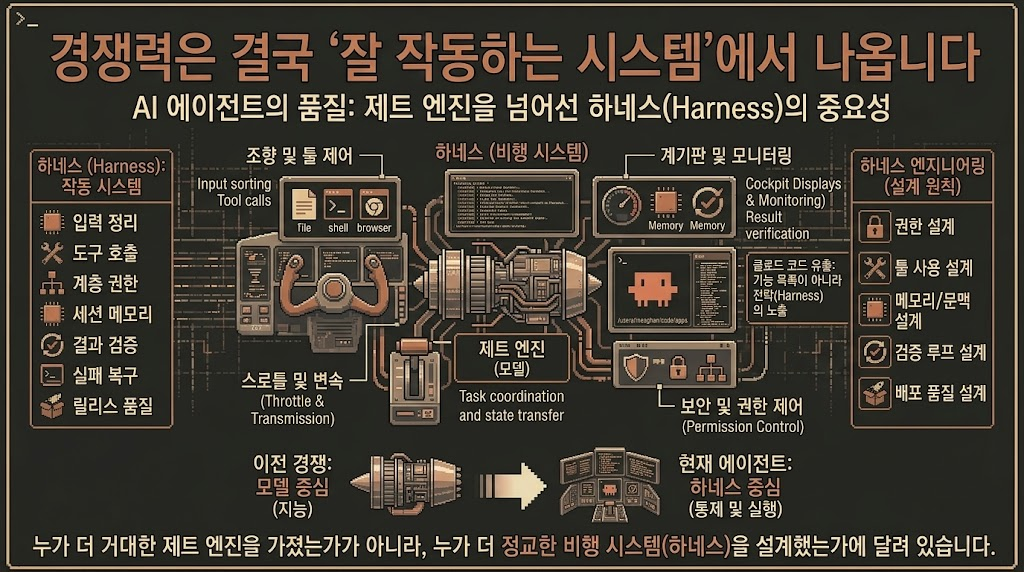
Therefore, in the age of AI agents, competitiveness depends less on the model itself and more on
how well that model is made to operate within the organization.is where the difference lies.
The recent Claude code leak incident clearly demonstrated that fact.
On the surface, it was a code leak incident, but
what was actually revealed was something far more important.
Now the game depends not on
who has the bigger engine, but
who has designed the more sophisticated driving system.depends on.
And the name of that system is the harness.
In conclusion,
the agent era is not simply "an era where AI becomes smarter."
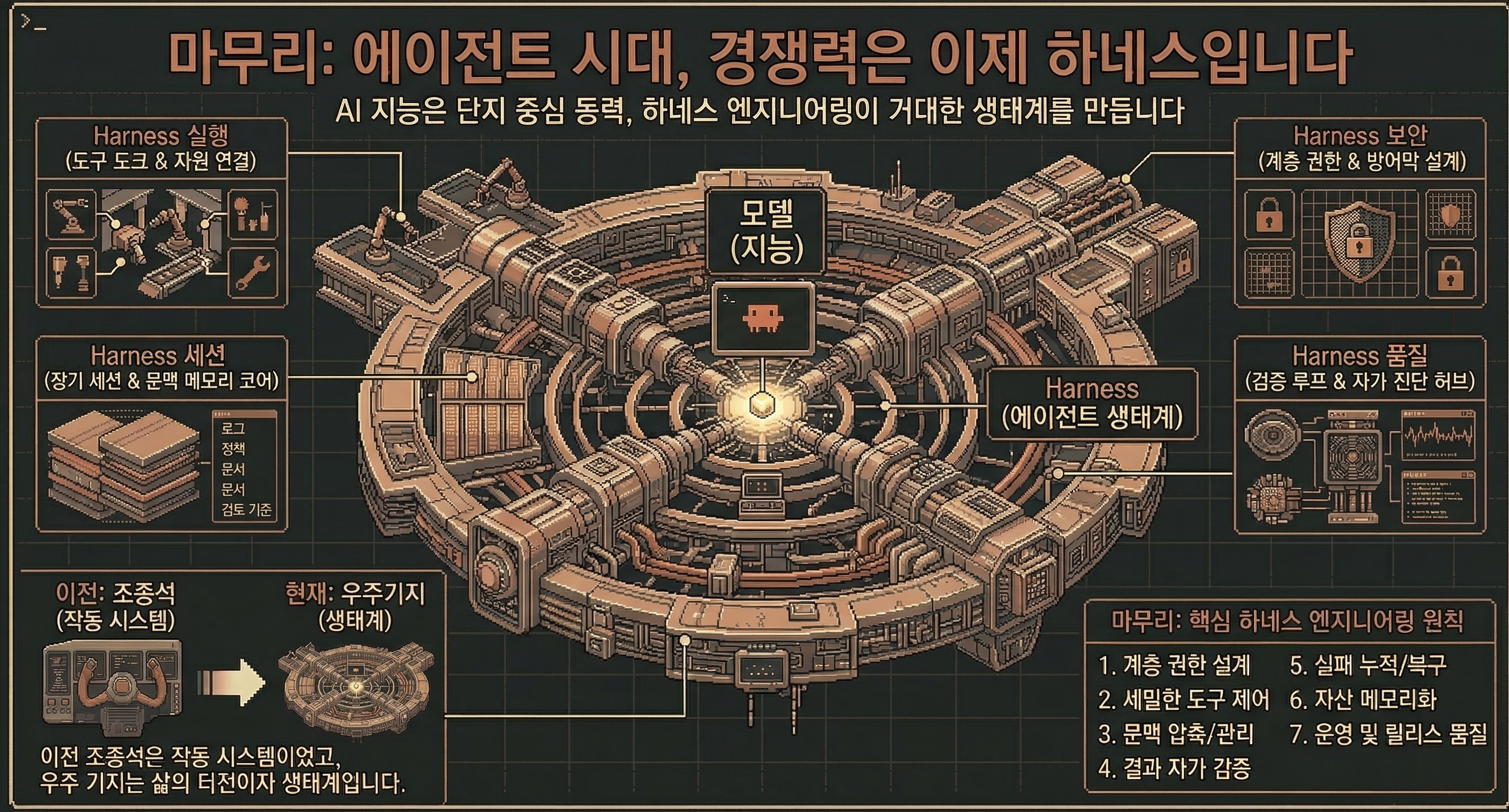
More fundamentally, it is
an era that asks how to transform AI into a controllable and sustainable system.
Therefore, future competitiveness
will not be explained by a single model performance table.
The real difference occurs in unseen places.
Permission design,
session management,
tool connections,
memory structure,
validation loop,
deployment quality.
That is, the harness.